The Empty Village of Little Men
by Graham Marema
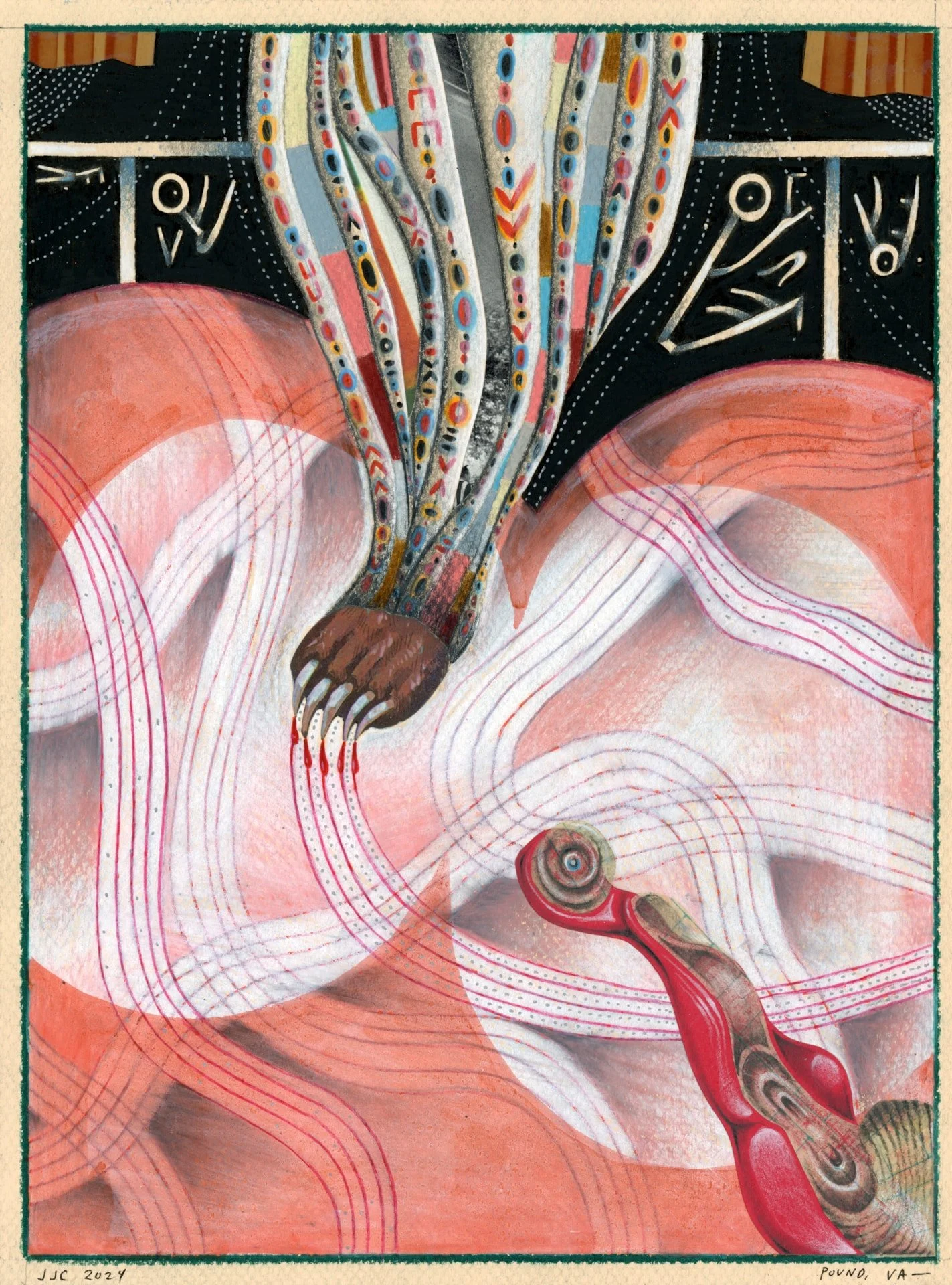
Image: “A Local Commotion” by JJ Cromer
The little men come out of the hills. They eat your smallest strawberries.
The little men are about as tall as your knee only maybe smaller because their pointy hats make them appear taller than they are.
“Appear” is the wrong word, because they do not “appear” anywhere.
Spill something outside, like a cup of tea or a glass of warm beer, and you may hear a shout. Yip! This is a little man calling out to other little men to beware of the puddle, where they could drown.
If it is Christmastime, which it is not, because the katydids are still chawing and the garden is tangled and plump, it’s nice to leave out a treat for the little men on the porch, and a treat means porridge, especially with a big dollop of melting butter on top. When people invented this folktale, if people invent folktales, butter must’ve been scarce, because now I can find butter easy in the second aisle of the grocery store when I bike to town on Wednesdays. But maybe the little men don’t know that.
You may wonder how a person like me knows all this. It’s because I heard it from Anders, who is my new neighbor.
“Leave it,” he tells me from his porch where he smokes a pipe shaped like a mermaid. He points the mermaid’s tail at the smallest strawberry in my mother’s garden, where I kneel in the sweet stinking soil in my too-big gardening jeans. The sun is low and white like an open mouth above Anders’ house. I raise my hand to shade my eyes, and sweat stings the shaving bumps in my armpits, and Anders warns me to leave the smallest strawberry alone or else the little men will get angry.
Anders is Scandinavian. He is the tallest man I know. His hair is so white it’s almost yellow, like polar bear fur. He moved into the house next door at the beginning of summer and there are still boxes on his porch.
The smallest berry is too wimpy to eat anyway, so I leave it. When I return in the morning, I find it gnawed to a pulp by tiny, ravenous teeth.
If the little men come out of the hills of Scandinavia, where do our little men come from? We don’t have any hills, only endless prairie unrolling in every direction till it zips together with the sky. Or it used to be that way, our house the only thing worth seeing for miles and miles except the distant dinosaur backbone of town over that way, until men in orange construction vests arrived in bulldozers and they built that neat row of white houses all around my parents’ property. The houses sat empty a long time waiting for families. Anders is the first to move in. I ask him about the hills.
“They don’t need hills,” he puffs. “They live in storm drains like the Teenage Mutant Ninja Turtles. They have teeny TV sets and sofas and stuff down there. But they get bored, so they come out looking for trouble. They don’t get cable.”
I don’t get cable either. I haven’t seen the Teenage Mutant Ninja Turtles. I tell Anders that I don’t watch cartoons because here’s the thing, I’m not a kid. I sit on the porch in the evenings with a glass of beer balanced on the railing and a book balanced on my knee. I don’t drink the beer. I just like the way the sun goes through it. Sometimes I don’t read either and instead sneak glances to make sure Anders has noticed me.
The little men can’t read, and they’re self-conscious about it.
The little men can’t be tricked.
I decide to trick one anyway.
I set a trap at the mouth of a storm drain. I put on my father’s black T-shirt and my mother’s long black skirt, and I slip out the screen door after Anders has rapped his mermaid pipe against the side of his porch and gone inside. Our street is so strange at this time. The empty houses look like plastic Tupperware with all the food scooped out, except for the one jaundiced eye of Anders’ window, and the newly paved street is gloomy blue and over everything is the sideways smile of the moon. Sometimes I pretend I can hear noises coming from the empty houses, radios humming, mothers scolding, fathers thumping up and down stairs, thump, thump, thump. I tiptoe down the dark street with a secret shiver in my stomach and kneel beside the storm drain which opens out of the curb. A breath exhales against my mouth. I’m scared, just for a minute. But it’s not the breath of a little man. It’s the breath of the town in the distance. I know because I can smell the vinegary reek of garbage bins and car smog and yellow puddles swollen with cigarette butts. I don’t like the way town smells, or the long, sunburnt road to get there on Wednesdays, and I don’t like how strangers, who my parents warned me about, move their eyes up and over me in the grocery store aisles. But mother insisted I go there once a week with the money from the dresser drawer or I’d starve out here all alone, so I do what she says.
I set up the trap and run home and lie sleepless in my parent’s clothes, my heart begging my ribcage for release.
In the morning, the stick is snapped in half and the box is upside down. Inside the box is the head of a mouse, cleanly severed. Maybe with scissors.
“You made them angry,” says Anders when I show him.
“What do I do now?”
“Throw them a party,” he suggests.
I’m not so sure. I don’t want to reward the little men for this kind of behavior. I plop the mouse head into a Ziploc baggy and bury it in the trash, and I spend the day on the rug of my father’s office sorting books alphabetically because he asked me to take care of them after he left and it’s taking a long time because I like to hold each book open and press my face into the center crease and suck in through my nose. In my head, I rank the smell one to ten. Gone with the Wind, six. The murder mysteries, four. Bible, eight and a half. It’s always a relief when I look up and see the sky above his desk purpling. Now it’s time to pour a glass of warm beer and watch shadows pool like black floodwater in the empty street between the white houses. And now it’s time to sleep again.
The next morning, on our welcome mat, I find a bird with an arrow through her chest. I kneel beside her without touching, because mother warned of diseases that dead birds carry. The arrow is about as long as a popsicle stick. It pokes out of the bird’s chest exactly where her heart must be. The bird is bent backwards, her neck arched like a pretty lady who’s fainted.
“Throw them a party,” calls Anders from his porch.
I want to pick up the bird and hold her in my hands like an old book, bury my nose in her feathers. I think she would smell a ten. I feel a need to tuck her away, in my mouth maybe, a safe soft place in the dark. I turn toward the garden so Anders won’t see the wet on my face, and I go inside for gloves.
Here’s how to throw a party for the little men.
Make oatmeal if you don’t have porridge, or don’t exactly know what porridge is. I only have packets of instant cinnamon oatmeal, the kind with flecks of dried apple that rise to the top like capsized rowboats. Leave the bowl of oatmeal in the backyard. Don’t forget the dollop of butter. Surround it with bottle caps for plates. Fill your smallest mixing bowl with two warm beers from the cases in the garage. This will be their punch bowl. Prepare a tray of the smallest berries from your garden and hang up a banner of toilet paper across the back porch which says: SORRY LITTLE MEN. HAVE A NICE PARTY! Open the kitchen window, set your radio on the sill, turn it to the oldies station, and leave.
You’ll be tempted, of course, to peer out the kitchen window and watch. But Anders says the little men don’t like to be spied on. To avoid temptation, take a book onto the front porch and sneak glances at Anders smoking.
When Anders sucks on the pipe, his cheeks go in like backwards parentheses. My parents warned me about strangers but they never met Anders and anyway he isn’t such a stranger anymore. I imagine one day I will offer him one of my father’s beers. I will be wearing lipstick when I do this. Anders will see the chalky red stain along the lip of the glass where I sipped. He will want to erase it with the callous of his thumb.
“Did you throw your party?” Anders calls from his porch.
“Mhm,” I say. I turn a page, real slow, like this. “How long should I leave them?”
“They’ll be at it all night. Can’t you hear them?”
I tilt my head to the side to pretend I’m listening, because I think it probably makes my neck look long and thin. My neck is my best feature. But I don’t hear anything except the radio. Hey, hey, we’re the Monkees…and people say we…
“Yes,” I say. “Are they always so loud?”
Anders raps his mermaid pipe against the side of his porch. “Night,” he says, and goes in.
I barely sleep. It is agony not to look out the back window and see whether the little men like the party. If they don’t, will they fill my mailbox with poor lifeless creatures? Sad frogs and crushed snails and dead baby foxes? I stare at the woozy darkness of my parents’ bedroom ceiling and imagine what the little men look like. They’re old and have noses like stubbed toes and ears like chewed up corn cobs. Their eyes are green, no their eyes are black and gold, and their teeth clack when they eat, when they laugh, when they sing their songs. I dream of the little men and the dreams make me sick.
In the morning, I step onto the back porch. The oldies station is still playing from the kitchen window. When you’re alone and life is making you lonely, you can always go…
Here’s how you can tell the little men liked your party.
The porridge has been gobbled. The punch bowl is overturned, drained of its last drop. Someone has scribbled an obscene drawing onto the toilet paper banner.
The little men can be real slobs.
But Anders was right. The little men have forgiven me. I know because instead of a dead bird, they left me a painting propped on the overturned punch bowl, sweaty with dewdrops.
It’s about the size of a postcard. A woman reading a book, her chin tilted to display a lovely neck. Late evening sun brightens her edges. It takes me a long time to recognize myself. I hold the painting in my right hand and touch my heart with my left. My insides get all twisted.
I didn’t know the little men were artists. I ask Anders.
“Not really,” he says, his mouth pasty with smoke. “They dabble.”
“One of them made me a painting to say thanks for the party. Wanna see?”
Anders coughs. “Don’t you have school?”
“It’s summer,” I tell him. “And anyway I graduated.” I like lying to Anders. The lies melt on my tongue like ice cubes.
“Your parents leave you alone in that house all day?” Anders is looking at me a little more closely than usual. I see his eyes roaming through the smoke like the eyes in the grocery store aisles.
“Why not?” I say. “I’m old enough.”
“It’s strange,” he says, as if this just occurred to him. “You just always seem to be alone.”
“I like to be alone,” I say, and I tell him I have to make breakfast, and I go inside. Sometimes Anders can be very stupid.
I set the painting on the mantle. I find excuses to walk past it throughout the day. I investigate the teeny strokes and imagine a hand scooching a paintbrush along my ears, my fingers, my throat.
I spend the afternoon in the shed. That’s where my father keeps his tools and the stacks of old cardboard clotted with spider eggs. You’ll find everything you need in here if something breaks, father told me, and you’ll be fine, he added, just fine, except I’m afraid you might get lonely sometimes. Yes, mother agreed, looking worried, in fact I’m afraid you might be very lonely once we’re gone. I was worried about that too, for a while. But they couldn’t have guessed how close the orange-vested men would build, how the view of our neighborhood would transform from that blank brown sheet of prairie grass into those rows of white houses perfect as baby teeth. My parents wouldn’t even recognize it, I think. And one day soon the houses will fill with families and I won’t have use for a word like lonely anymore and one day I’ll probably forget what it means.
My first cardboard house is crooked. I bind the windows in plastic wrap, the roof in duct tape, the floor with spongy carpet made of an old sweater that smells like basement. But I’m impressed with my cabinets, which have real working doors attached with bent paper clips. I build a dining room table out of an old shoe box. A bed out of one of my mother’s hats. A sink, which is really just an old coffee mug filled with tap water. I paint the house yellow from the leftover rusted can in the shed, which stains my hands and soon everything I touch. I leave buttery fingerprints on light switches, door handles, and parts of my body that itch.
“Do they like natural light?” I ask Anders. “Or do they prefer dim?”
“Dim. Reminds them of the skies in Scandinavia.”
“Will they bring pets with them?”
“Rats, if the rats will come.”
“Are the rats trained?”
“Like dogs. They even fetch the newspaper.”
“I thought the little men couldn’t read.”
“They use the newspaper as fire starters.”
“Should I build them fireplaces?”
“Where else will they hang their socks?”
After I’ve built three houses, each less lopsided than the last, the little men move in. One morning I find a patched coat slung across the coat rack I made out of popsicle sticks. Bottle caps soaking in the sink, scummy with dried porridge. Tiny paintings on the walls of mountains and red houses in the snow, of Scandinavian women with open mouths, pink tongues sliding wetly behind rows of beautiful teeth. I bristle at the sight of these women. I resist the urge to peel their bodies off the walls and drown them in my morning tea.
“They’re nasty,” I complain to Anders. “They have lewd pictures on their walls.”
“Build them a church,” Anders suggests.
Soon the little men will invite me over for lunch. I’ll be too big to fit through the front door so I’ll have to take the roof off to say hello. We’ll laugh about it. They’ll stand on their tiptoes to hand me bottlecaps of porridge. I’ll eat and eat and eat. I’ll eat a hundred of those things and I’ll still be hungry but I’ll thank them anyway and I’ll lie in the summer-brittle prairie grass while they take out their instruments and sing something sad about Scandinavia, a snowy place with a trillion stars, a place where little men bow hunt in the cold rolling bellies of the hills with their baying long-haired dogs, where the women are left behind to do dishes and gaze out the black nighttime windows and wonder, wonder.
Anders is wrong. The church doesn’t help.
More paintings appear of heavy-lidded women who keep secrets in the corners of their mouths, and soon there are lacy black stockings hung beside the socks on the mantle. I want to throw these out when I find them, and the wicked crimson lipsticks by the sink. But I think of the severed mouse head and try my best to ignore them. I dream about the women. I dream they laugh as I’m hunting for my parents in the prairie, and their laughter confuses me. We’re here, comes my mother’s voice, come find us, but it leads me into town where strangers without faces follow me down grocery store aisles and tie knots in my hair that will never come loose.
I wait for the men to paint me again. I sit very still on the porch in the evenings in case they’re hiding across the street with their tiny easels. But they have lost interest, I think. I am beginning to lose interest too. The summer is unending, the days long and syrupy, the houses on our street still vacant and dull-eyed. Soon the families will move in. Soon the long hot afternoons will give way to short winter sprints, where there are fewer hours to fill before night. My parents left me housework to do after they left, all the important jobs of cooking and washing and mending, but it is not enough, never even close, and I am dying under the weight of hours that ask for nothing. I sit on the porch with my undrunk beer and my unread book and the scent of Anders’ pipe makes me clammy and I feel this big swell in my chest, right here, and I think I might split through the seams of my skin.
“Hot,” I call from my porch to his when I can’t stand it a second longer. “Horribly hot.”
Anders doesn’t respond. Just gazes into the rafters above his porch, as if there is anything at all to see up there.
“Parched,” I add, which is a word the women in the murder mysteries say. I tilt my head as I say this, revealing the sweat-slick slope of my throat. I am itchy all over with the want of something.
Anders sucks on his pipe. The parentheses go in.
“Can I come to your house?” I call. “For water?”
It must take Anders a moment to hear me. He opens his mouth and a bubble of white smoke announces itself. The smoke vanishes completely before Anders speaks.
“My house?” he repeats, sounding dumb. Sometimes he sounds that way.
“Your house.”
“Well,” he says, and after a moment, “yes, okay.”
I leave the book on my chair. I step off the porch in my bare feet, and for the first time this summer, the grass feels cool, like this is where autumn is being born. A shiver starts up in the smallest places of me and uncoils into the larger. I could spill in a million directions, as long and forever as the prairie.
Anders opens his front door. He coughs into his sleeve as I pass him.
I don’t realize until this moment that I must’ve pictured Anders’ house a certain way, because whatever way I pictured it wasn’t like this. The front door opens into the kitchen. Our front door opens to the living room. The wallpaper is tooth-decay yellow, the floor made of pale laminate pretending to be new wood. The kitchen counters are fake white marble with purple splotches like skin anomalies and everything smells like the cleaning supplies aisle at the grocery store, curdled with the mouth-souring scent of tobacco.
Anders closes the door and stands with his arms at his sides near the sink, the empty mermaid pipe dangling upside down from his white fingers.
“Water?” he says. His eyes look all over except into mine.
“Yes.” This is no longer a lie. My mouth is chalky.
Anders crosses the room and pours a glass of water from the sink. I notice a plastic frame on the counter. A woman with curly brown hair going gray at the crown. Her skin is pockmarked from flecks of sink spray. Anders hands me the glass of water, milky with bubbles. I accept and drink and the water tastes like paper.
“You said you graduated already?” he says. “Are you going to college or something?”
I take another sip, but my lips get drier. It’s not the water that tastes like paper, I realize, but the inside of my mouth.
“I didn’t get far in school,” says Anders. “I got a job on an ocean liner in the North Sea when I was a young man. We went out for months at a time in the freezing cold to test ice. Ice, isn’t that strange? The scientists would fish these big white chunks out of the ocean, all excited when they got one on board, like it was a prize tuna. They were testing for things that would change the face of science, that’s what they always said, the face of science. There was one day I remember they ran their tests and found something in the ice they were looking for, and they all cheered and we got drunk that night and some of them even cried. I guess the face of science had changed. I didn’t notice much being different after that. And I never saw anything but white in the chunks of ice, myself. I guess that’s why I was the lab guy, basically a janitor, you know.”
I can tell he wants me to ask him a question now, but I don’t.
“Your parents must trust you a lot,” he says. “To leave you alone so much.”
I move my shoulders kind of like a shrug.
“Is the water okay?”
I will say, Yes, thank you. I will say, No, something stronger, for heaven’s sake, Anders, like the girls in the murder mystery novels. I will not say anything, because Anders’s eyes have finally found mine.
“Do you want to go to another room of the house?” he asks.
A word finds its way out of my lips, “No,” in a peculiar tone I don’t recognize, and I am furious with myself. Yes, I should have said. And he would have led me into the heart of the house, which would look how I’d hoped it would, lined with books like my father’s office, with real wood floors and a long-haired dog asleep on a rug. Yes, I should have said. Yes, I still could.
Anders catches me looking at the curly-headed woman by the sink.
“Oh, that’s a silly story,” he says. Creases appear at the corners of his mouth. I have never seen him this close, never known about those lines. “I shouldn’t tell it.” He leans against the counter, closes his eyes, and opens his mouth, as if he is about to start speaking for a long, long time.
I set the glass on the counter with a too-loud clack. Anders’ eyes are still closed, his mouth hinged open. It looks like he is waiting for me to put my fist inside. I walk out the door and step off the porch and the grass is wet and cold. A light rain is shivering out of the prairie, new black clouds yawning over the bony spine of town, the world has changed while my back was turned.
I follow the sound of the radio into the backyard. Buddy Holly, one my father hates. Every day seems a little longer, every way, love’s a little stronger, come what may, do you ever long for… The creeping drizzle freckles the brown skin of the cardboard houses. They droop in the wet. The plastic wrap windows peel like old sunburn. I pull off the roofs and find that the little men have moved out all their things, their socks and paintings and their vile little lipsticks. There is no sign they were ever here. Sometimes Anders isn’t the only one who is stupid.
Tonight, I decide, I won’t sleep, not a wink. Who is there to make me? I put on my mother’s black dress. I apply her lipstick. I drag out the case of warm beer from the garage and crack open the rest of the cans and pour them into glasses that I line on my father’s desk and then drink each one with my nose plugged because they taste like they’ve gone bad. I turn on all the lights in the house, which make the black night in the windows even blacker, so that I couldn’t see even if someone was standing right outside. But that doesn’t scare me. I can wave to whoever I imagine might be there, all the little men with their clacking teeth, and all the neighbors with their babies who moved into the houses and are coming over with baked lasagna, and my parents, even though they said once they left they could never come back, they’d say here we are, we’re home again, we were only joking. Come in, there’s plenty for all of you, I say, which isn’t quite true because now I’ve drunk most the beer and I don’t even have to plug my nose anymore, I take down all my father’s books and line them up like soldiers. I send them into battle. Gone with the Wind is dead in seconds. Death on the Nile pulverizes Murder on the Orient Express. The Bible deserts.
I wake when the windows pale. My heartbeat has moved to behind my eyeballs. It thumps and thumps until I realize it’s not my heartbeat but someone knocking on the front door. I lie in the battlefield among the dead soldiers. I lie there until the knocking stops. I smell a mix of fours and three and nines, and I breathe it all in, and I get sick on myself. I guess the beer really was bad.
When I can stand, I walk through the house on untrustworthy legs. I feel a nasty swell of something bad I can’t name at the sight of the mess I have made, and every lamp left on all night, caking the bent books in a gleeful yellow crust.
Sometimes, I’m embarrassed to say, I let the house get like this. Dirty dishes and sick on my mother’s clothes and the stink of sweat on my skin. I’ve tried my best to clean, to weed and dust and do all the things my parents said I’m old enough to do on my own. But the summer days are long and short all at once, and I will spend whole hours somewhere in the house and not realize how long I’ve been there. And the dishes pile, and the fridge smells. The garden is full of weeds and my father’s books all over the floor again and my body is unwashed, I have left yellow fingerprints on all my parents’ nice things. I’m ashamed to see the places I’ve touched.
I will clean today. I will clean it all today. This will be my deepest clean yet and the house will be fresh and pink like my skin after a shower and in the afternoon I will bike into town to buy the smallest picture frame for the painting of the tiny beautiful woman, which I will hang beside the front door, right here. Anyone who comes into the house, her throat will be the first thing they notice. How beautiful, they’ll want to touch it. I will be able to stand it all if I do these things, mostly because I don’t think it will be this way forever. Nobody ever told me it would be.
Graham Marema is a writer from the blue hills of East Tennessee. She received her MFA in creative writing at the University of Wyoming with a concurrent degree in Environment & Natural Resources, and she currently lives in Philadelphia. Dreams, ghosts, and SPAM often appear in her writing.
Instagram: https://www.instagram.com/grahammarema/
Website: https://grahammarema.com/
JJ Cromer is a self-taught artist from Virginia. His work is in several public collections, including the American Visionary Art Museum, the Intuit Center of Outsider Art, the High Museum of Art, and the Taubman Museum of Art. He and his family live on a farm in central Appalachia, where they have kept chickens, ducks, geese, and bees. www.jjcromer.com IG: @jjcromer