Saint Joan
by Chelsea Lane Campbell
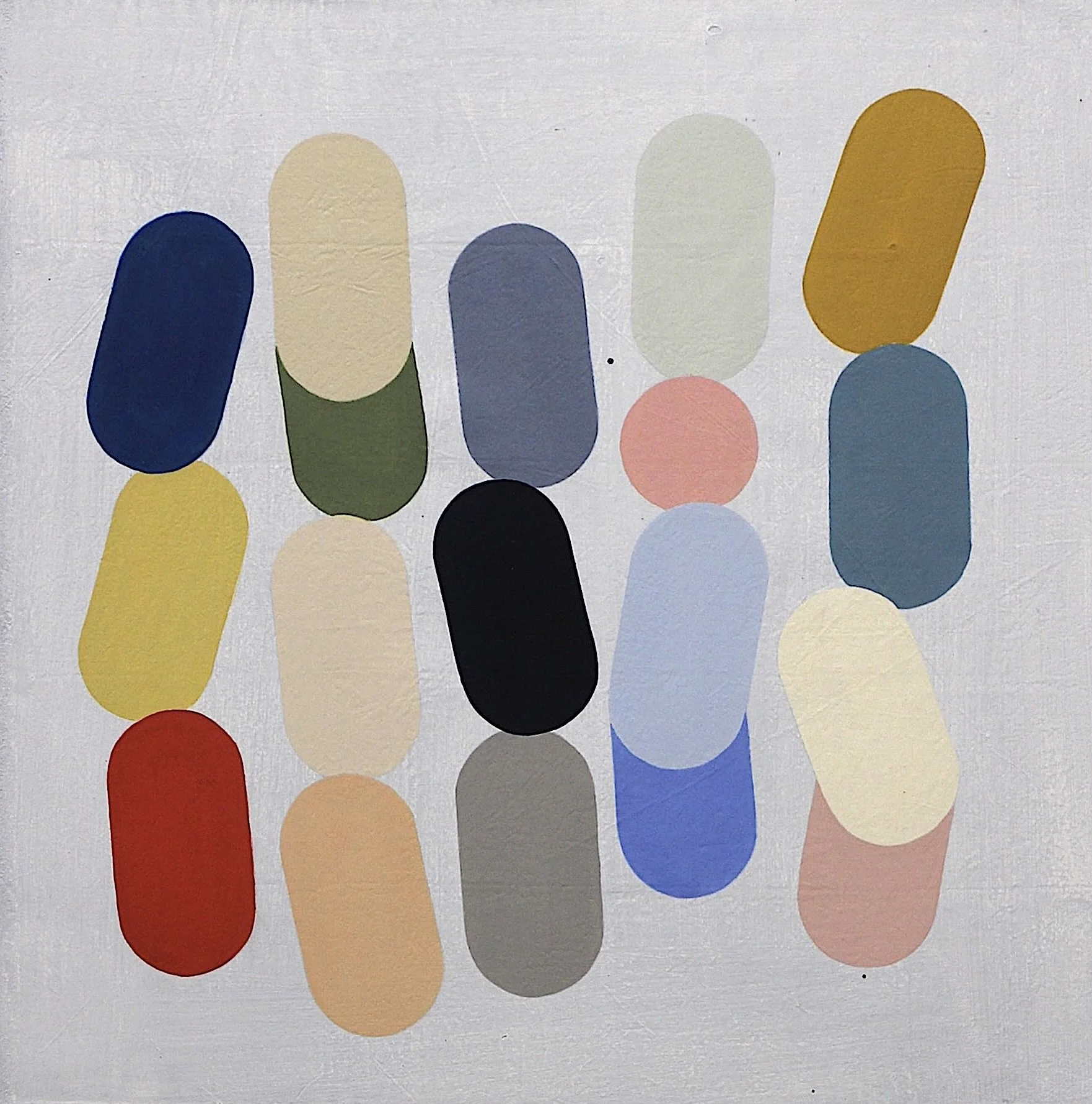
Image: “MultiLozengeStacks” by Jean Wolff
Dilemma
Joan Didion’s Notes to John was posthumously published on April 22nd, 2025. Despite my deep adoration for Didion, I waited a month to buy the book, and a year later, I’ve still not dared read it.
My ethical hangups about reading the book seem obvious. Like many other high-profile posthumous publications, the suspicion is that Notes was a gross violation of privacy and an exploitative cash grab on the behalf of the estate’s executors. In fact, the news and review coverage of Notes to John was pretty one note: The book ought not to exist. Didion, the literary icon she is, could have published her handwritten shopping lists if she had wanted. Apparently she did not.
In the last book Didion did choose to publish, she included an article she wrote for The New Yorker entitled “Last Words.” In it, she decries the publication of Hemingway’s selected letters as well as all the books published after his death, comparing the publications with the absurd, capitalistic bastardization of the “Hemingway Collection” of furniture by Thomasville.
Didion originally published “Last Words” long before it could be clearly seen as a commentary on her own wishes or work. But after choosing to collect and reprint it in the final book she authorized? That’s more suggestive. Didion lived into her late 80s. Certainly her estate and legacy were on her mind putting that last collection together.
I know and buy into these reasons for not supporting Notes to John. My reasons for nonetheless feeling drawn to it, however, aren’t so obvious or easily defined.
I’ll Come Running
For as long as I can remember, a gold cylinder on a long gold chain has hung in my mother’s jewelry box, something her mother made her when she was a child. While she did her makeup one morning before church, I took the chain out and held it in my hand.
“What’s this?” I asked.
A little smirk formed on her face.
“Oh this?” she said, taking the delicate chain in her own thin fingers, now pining. “This was a gift from a boy I dated in high school. He was so in love with me. It’s a whistle,” she continued, positively wistful. “He told me to blow it any time I needed or wanted him and he’d come running.”
I was a hopeless, unapologetic, uncaught snooper. I snooped out in the open, looking through my parents’ old photographs on a Sunday afternoon, but also sneaking into my mom’s room when she was at work and reading her journal.
A small catalogue of boys ran through my mind, thinking of the whistle. Was he the boy with the David Cassidy haircut? The boy whose lap she’d sat on for the Sadie Hawkins dance photo, a large rattan chair underneath them? Had he been the one to take the photo of her in the small, tiled space above the boy’s urinals in her high school? Or the photo of her tanning by the side of her family’s newly constructed pool, a posed annoyance on her face? Had he been the one to sing her Beatles songs? “Baby, It’s You?”
I knew nothing else about these boys. I didn’t know their names, how she met them, whether she liked them. I knew her high school was the one where, eventually, Kevin Bacon’s Footloose was filmed, which was cool, but I knew little else. My mother, the apparent enigma. My parents divorced when I was 10 or 11, so even the lore of my parents’ love was a story I didn’t hear often, and never with wistfulness. So, who was this boy that could still make my mother get that far-off look in her eyes? There was so much about her I did not know, and it wasn’t until that moment with the whistle I realized how much I was missing.
I took the chain back. My mother returned to her makeup. I lifted the whistle to my small lips and blew it softly. No one came running. I wasn’t surprised, but I had to try.
To Know and Be Known
In college, I told the man who’d become my boyfriend to snoop around my room, and I promptly left it for some made up reason. Rifle through my things. Read my journal. Smell my sheets. Know me.
I returned a few minutes later to him sitting patiently, waiting for my return. He had not snooped, told me as much.
How damn respectful. And how inconsiderate.
Why Essay?
CNF writers love to talk about the origin of the word “essay”: Latin, then French. To attempt. To try. To test the quality of. Of what? An idea, a potential answer. In a genre that is somewhat lawless and where the task is always the arrangement and presentation of material rather than its fabrication, attempts are sometimes all we have.
Sometimes I think I write CNF out of that desire to be known, which is really a strange ouroboros. I desire to be known because I am so often not. Before the publication of The Dry Season, Melissa Febos wrote, “Like most memoirists, I am a secretive person. The idea that memoirists are oversharers who crave attention is erroneous; we are usually people who have hidden large swathes of ourselves in order to appeal to others, to feel safe. By the time we write our memoirs, those concealed parts have become too heavy to bear. The problem with secrecy is that it isolates us, alienates us from the companionship engendered by a shared truth.”
Febos goes on to quote D.W. Winnicott, a quote she also used as an epigraph in her book Abandon Me: “It is a joy to be hidden and a disaster not to be found.”
I read Didion because often, in her work, I feel found. I feel companionship engendered by a shared truth. Especially lately, I’ve found myself rereading the bits of Didion’s work where she describes her neurosis, how difficult it is for her to write. Here’s the whole last paragraph of the introduction to Slouching Towards Bethlehem which I appreciate, in part, for its length, its overwhelming, emphatic struggle:
I am not sure what more I could tell you about these pieces. I could tell you that I liked doing some of them more than others, but that all of them were hard for me to do, and took more time than perhaps they were worth; that there is always a point in the writing of a piece when I sit in a room literally papered with false starts and cannot put one word after another and imagine that I have suffered a small stroke, leaving me apparently undamaged but actually aphasic. I was in fact as sick as I have ever been when I was writing Slouching Towards Bethlehem; the pain kept me awake at night and so for twenty and twenty-one hours a day I drank gin-and-hot-water to blunt the pain and took Dexedrine to blunt the gin and wrote the piece. (I would like you to believe that I kept working out of some real professionalism, to meet the deadline, but that would not be entirely true; I did have a deadline, but it was also a troubled time, and working did to the trouble what gin did to the pain.) What else is there to tell? I am bad at interviewing people. I avoid situations in which I have to talk to anyone’s press agent. (This precludes doing pieces on most actors, a bonus in itself.) I do not like to make telephone calls, and would not like to count the mornings I have sat on some Best Western motel bed somewhere and tried to force myself to put through the call to the assistant district attorney. My only advantage as a reporter is that I am so physically small, so temperamentally unobtrusive, and so neurotically inarticulate that people tend to forget that my presence runs counter to their best interests. And it always does. That is one last thing to remember: writers are always selling somebody out.
If Didion can struggle this much to write, perhaps that I struggle means nothing more than I am writing.
And Yet
I never really stopped snooping in my mother’s drawers, aching to get to know her in a way I never really could as a child. I wanted to know her heartbreaks, the details of the divorce, how she was coping. I remember looking for things in her journal about me. I do not remember if I ever found any, nor do know what it means if I did find writing about me and yet don’t remember it.
Eventually I outgrew my mother’s recorded experiences, started doing things she’d never done: going to college, cheating on a boyfriend, becoming a writer, struggling with creativity, facing anxiety about unknown diagnoses and disability, leaving the religion of my ancestors and facing the utter chaos of the universe, wading through the very real anticipatory grief of being promised eternity and realizing my time was finite. Even if she had experienced those things, she’d never told me how it felt. She never wrote it down. And anyway, she’d stopped writing in her journal long before then. When things got hard, she ceased writing.
But Joan didn’t stop writing when things got hard. Joan showed me her very real grief. I watched her love. I watched her grapple with disability and motherhood and creativity and the senselessness and futility of life—with beautiful prose and unparalleled insight.
And yet.
And yet my appetite for this maternal insight has not ceased. I am still the small girl holding the whistle in her hand, wanting to know more. Wanting someone to come running, to rescue me.
Saint Joan
Despite leaving religion, I still appreciate the ways in which believers work to personalize a relationship with the Divine. (I remember, growing up, scribbling out all the addresses to other people in my scriptures and replacing them with my name so it felt like God was talking to me. Blasphemy? Depends on who you ask.) Specifically, I still feel drawn to the idea of patron saints, someone who gets you—or at least gets what you’re going through—and making an appeal for them to intercede on your behalf.
I am not the first to try on the idea of Joan Didion as a patron saint, but where others seem interested in redirecting or complicating Didion’s work and legacy, I am happy to interact with the woman who might just be my patron saint as a usefully simplified figure. (Cynical? Idealistic? Depends on who you ask.)
Saint Joan who knows my wants, my troubles, my self-doubts. You are my mother and my inspiration. Hear my prayers.
What Are You Writing About?
“What are you writing about?” my daughter asks, noticing I’m typing this very essay. We are together in my bed. She is home sick from school on the last day before winter break and she’s reading over my shoulder while I work.
“It’s Christmas break,” she shouts, “not winter break.” It’s the loudest revision note I’ve ever received.
She’s not wrong, they do call it Christmas break in all but print at her school.
She’s bored. I don’t blame her. I thought I’d have the day to write and my tenure clock is nearing midnight and so she’s been my sickly companion while I click clack away on my keyboard while she patiently plays games, reads stories (“Tell them it’s Calvin and Hobbes!”), and, now, reads these sentences as I type them. As much as I snoop, I’m not sure I’d ever be interested enough to watch someone type out their sentences, slow and stuttering.
“No kidding,” she says in response. “But what is your narrative about?” she asks again.
“Do you really want to know?”
“Yes,” she says.
I sigh. It might help me to get the story out of my head and into my mouth. It usually does. I’ve gotten lost in the weeds a bit, if I’m being honest. But I repeat things, explain too much for my daughter’s attention span for grown-up things. (“No you don’t!” But I do. She’s just kind.)
Maybe today she’s just sick enough, just bored enough, that it won’t matter. She’s been learning to write “narratives” of her own in school and has become more interested than usual, in books, in stories, in my writing. She’ll ask me what I’m working on when I tell her I’m going to my office. At the end of the day, she’ll ask me if I wrote about her. She’ll grin her beautiful, gap-toothed childhood grin when I say yes because when I can write, I’m always writing about her.
I pick up my copy of Notes to John. “I’m writing about this woman.” I’m carrying the book with me everywhere, a talisman, even though I refuse to open it. Didion is on the cover. “Her name is Joan Didion and she’s one of my favorite writers.”
And I tell her. I tell her about snooping and her grandma. (“If grandma still has that necklace, will you ask her to send me a picture of it?” I nod.) I tell her about Joan and Ernest and diaries.
“Is this narrative what you were talking about with daddy yesterday while I was in the tub?” my daughter asks. “Hemingway?”
“Well, Didion and Hemingway, yes.” I said. “But it’s mostly about Joan.”
Yesterday, before we knew she was sick, she took a long bath after school. I took the opportunity to re-read some essays, to keep working on mine. I asked her if she wanted her waterproof e-reader, thinking if she read in the tub it might buy me a little more time. She opened Calvin and Hobbes. (“Good job, saying it was Calvin and Hobbes. You knew I wanted you too, huh?” I did, my love.)
My husband poked his head in the bathroom to check on us. I asked him a question about Hemingway (he’s read far more of Hemingway than I have) which he answered by retrieving books from our library, one by one, reading passages aloud, then leaving to get another. Volumes piled up on the bathroom floor.
In the tub my daughter shifted to a game of “spy.” She put on a pair of goggles, opened a note on her e-reader, and started typing out what her parents were saying: “talking about Hemingway…gadspy…hand quotes…warts…money…how dare he…horing…public.”
In bed, I ask my daughter if she understands why people don’t like the idea of Joan’s book. “Would you like other people reading your diary?”
I expect her to be bothered, but her face seems surprisingly neutral, like she wouldn’t care either way, and I remember her first locking diary from the school’s book fair. Upon arriving home with it, she loudly declared that her dad and I were NOT allowed to read what she put in it. (She’s giggling. “I did do that,” she says. “But I would say I decreed it.”) She sat at the table scribbling secrets I did desperately want to know.
“Don’t peek!” she’d say. And I didn’t.
After about an hour, she had changed her mind. “Momma, do you want me to read you a page of my diary?”
Maybe she follows in my footsteps more than I expected, wanting to be know, as well as being a snoop. Even as a spy, my daughter wanted to be seen. When I wasn’t seeing her enough, she asked me to spy back—to snoop her snooping. To see her writing. And I did. She’d peek over the edge of the tub, her beautiful eyes (“Blue eyes,”) her beautiful blue eyes cresting the edge of the tub. When I’d glance over at her and catch her gaze, she’d flop back down in the water, releasing a healthy splash. Again and again, she’d eavesdrop. Splash. Giggle.
“You like eavesdropping, don’t you?” I asked her. Then, “You know what eavesdropping is, right?”
“Yes,” she said. “I learned it from a book.”
I said yes, if you’re wondering, about her reading her diary to me. Of course I did. But you know that by now, don’t you, my dear reader?
Tenure Tick
Much to my dismay, I’ve started to follow the precedent of my actual mother, who stopped writing in her journals at all, instead of my spiritual mother who wrote hundreds of thousands of words to process her experiences on this planet. I now have only three months left to meet my tenure publication requirements or I will be dismissed from my position.
Implacable Joan, mother of fatalism, Our Lady of California. Be my light and my strength in this, my time of need. Grant me the courage and strength to endure this endless struggle.
Hemingway, in the posthumously-published A Movable Feast, criticized F. Scott Fitzgerald for being a sellout. “He had told me at the Closerie des Lilas how he wrote what he thought were good stories, and which really were good stories for the Post, and then changed them for submission, knowing exactly how he must make the twists that made them into salable magazine stories. I had been shocked at this and said I thought it was whoring. He said it was whoring but that he had to do it as he made his money from the magazines to have money ahead to write decent books.”
My first encounter with this passage was my husband reading it aloud to me while I sat cross-legged on the bathroom floor, surrounded by books, our daughter spying on us from the tub. My immediate reaction was annoyance with Hemingway who clearly did not yet understand the pressures of supporting a family in middle age, something I am currently steeped in, the primary breadwinner, the retirement account owner, the carrier of the insurance. I’d driven my husband to the ER at 3 in the morning just days before, my daughter equal parts scared, patient, and sleepy in the backseat. Stability was nothing to dismiss.
There on the bathroom floor my bookish husband delivered an impromptu lecture on a writer he loves and cited his sources. I spied my daughter spying on her parents after reading in the tub. Books were stacked high around us. The bathroom was warm and humid, a blessing in the desert. Our bellies were full. Happy in my stability, I thought: How idealistic of Ernest, and how terribly shortsighted.
My need to write is terrifyingly real and terrifyingly consequential. Get the pubs, keep the job. Don’t get the pubs, upend my whole small family’s whole big life. And what else would I do anyway? I, like Joan, am “simply a writer, a person whose most absorbed and passionate hours are spent arranging words on pieces of paper.”
This is coarse to acknowledge in a public-facing essay, isn’t it, dear reader? It makes you uncomfortable, doesn’t it? It’s too much like a diary, my overwhelming list of issues, my desperate groping for material. You are my college boyfriend, sitting in your chair, rejecting the confusing intimacy of my disclosure.
What Are You Writing About?
“I’ll stop snooping,” my daughter says in bed. She doesn’t mean it. She likes watching herself show up in my essay the same way kids love to see themselves on camera. Ah, there I am.
I rake my fingers through her curly, unbrushed hair.
“I don’t mind, baby, I promise.” I say.
And I mean it; I don’t mind. It’s kind of everything I’ve ever wanted in the world. For someone to know me—to want to know me—so much that they’d snoop. That they’d read my writing—the shitty version, even. It’s an act of love, you see? She loves me. And I know it.
Sellout
A few years ago, an outstanding student of mine wrote an essay-as-tirade against posthumously published works. My student argued that the publications were a gross invasion of privacy and ought not to exist. In a feedback meeting on an early draft, I told them that they weren’t yet acknowledging a steep contradiction in their writing.
“But don’t you see the irony?” I asked gently. “You’re tearing apart those who published, bought, and read these writers’ works…but you bought and read them, too. This narrator doesn’t realize they’re part of the problem.”
My student seemed surprised, seeming to have never considered it was a choice to not read the authors—nor to recognize there may be literary value in their letters.
Writers are always selling somebody out.
Here’s the thing about Joan Didion’s article decrying the posthumous publication of Hemingway’s work: It’s clear she’s read it all. The selected letters, A Movable Feast, Out of Africa. All of it. Did she not realize her own hypocrisy? Or was Hemingway, one of Joan’s literary heroes who had his own strong feelings about sellouts, just the one to be sold out for that essay?
Why I Write, I I I
“I imagine…that the notebook is about other people. But of course it is not …The common denominator of all we see is always, transparently, shameless, the implacable “I.”
“I
“I
“I”
This is about me, isn’t it, Joan? Not you at all: I, I, I . . .
Paper Tombstones
My daughter went through a phase when she was about 7 where she’d ask for stories about when I “was little.”
“Tell me a story about playing on your playground.”
I would try, but I never had the stories she wanted—or at least not enough of them.
“I don’t remember any more, baby,” I’d say, and the disappointment on her face broke me every time. My memory is bad. I want to tell her everything, but I don’t remember it. I have to write it down, and I haven’t been writing things down.
In her breathtaking book When Women Were Birds, Terry Tempest Williams, who came from a family of Mormons, writes of inheriting her mother’s journals.
“But promise me that you will not look at them until after I’m gone,” her mother says.
Tempest Williams promises. A week later, her mother was gone, and a month after that, she goes to finally read them only to find out every single one of the shelves and shelves of her mother’s journals are completely blank.
In a dark room late at night, I shared this anecdote with my husband.
“That’s devastating,” he said. And then immediately, just as I did, he thought about our daughter. “I started a journal of writing to her when she was weeks old. Do you remember that?”
I did. I do.
“I think I only ever filled out two pages.”
Tempest Williams, then the implacable I, I, I. Didion would get it.
“I do not know why my mother bought journal after journal, year after year, and never wrote in one of them and passed them on to me. I will never know. The blow of her blank journals became a second death. My mother’s Journals are paper tombstones.”
Of course, I do not know why Tempest Williams’ mother’s journals were blank either, but I know why so many of my Mormon mother’s are. I know why so many of mine are. It’s tied up somewhere in the expectation for Mormons, especially Mormon women, to be happy, to hold everything together, to make things go right. Things going wrong in one’s life are often spun as one’s own fault. Pray harder. Fast. Read your scriptures. God didn’t move away, you did. Failure is always awash with shame and personal responsibility. And Mormons read their ancestors’ journals, share them in sermons, in publications. One’s recorded failures will be known in perpetuity. Who wants to know the failures of their progenitors?
Well, I did. I do.
Like Didion, I write to find out what I’m thinking, and I write to know and be known, sure. But it’s also clear that I write in the tradition of my Mormon mother-tongue, for my progeny: my daughter, the little snooper. To know and be known. I write both to circuitously keep our bills paid and our roof intact, but also, whether she cares about any of it or not, whether she’ll relate to any of it or not, I write so that I can stop telling her I don’t remember what she wants to know. So that I can perhaps be the author that can “find” her, offer her companionship engendered by a shared truth. If I can manage it, I will leave my child with my journals that contain not just a rote recounting of my days, but all my neuroses, my heartbreaks, my anger, my failures—all of it. She can learn it from a book. Forever.
It is enough to ask a child to suffer the death of their mother once. I will not leave her with a second death to reckon with.
Baby It’s You
“Actually, I will keep snooping on you!” my tiny turncoat says now, her tone finally more sincere, “for the rest of your life!” She shouts the last part in triumph.
A mother can dream—though I hope it’s the rest of your life, my love. It’s all for you.
It’s all for you.
Confession
I have a confession to make: I bought Notes to John only after conceiving of this essay. After I asked myself, incredulously, how there could be a Joan Didion book I did not yet own and the tentative answers started to come, after I could peek just enough behind the curtain that I knew I might have an essay, one that might help get me dig out of my publication-for-tenure hole.
So here I am, selling out my spiritual mother, not only by buying a book I don’t imagine she’d have ever approved of, but by talking about her with this wildly unearned familiarity. Because this essay that you, my gentle reader, are peering over my shoulder and reading for some blessed reason, is something I can write, sitting in my room “literally papered with false starts.” This is something for which, miraculously but also painfully, the words came, the holy sacrament of lisdexamfetamine capsule, but no gin, faithfully unknitting itself in my blood stream, allowing me to blunt the pain of the struggle to write.
From “On Keeping a Notebook” again: “Your notebook will never help me, nor mine you.”
Saint Joan, full of grace, it just may.
Amen.
Chelsea Lane Campbell’s work has appeared or is forthcoming in The Rumpus, Southern Indiana Review, Hunger Mountain, Gone Lawn, J Journal, and elsewhere. She earned an MFA from Texas State University and now teaches creative writing in Utah. With the publication of this piece, she has satisfied her tenure requirements. Huzzah! https://www.chelsealanecampbell.com/
Jean Wolff has had group and solo exhibits in various galleries in New York City and internationally. In addition, she has published 167 works in 114 issues of 62 magazines. Born in Detroit, Michigan, she studied fine arts at the Center for Creative Studies in Detroit and at the University of Michigan in Ann Arbor, receiving a BFA in studio arts. She then attended Hunter College, CUNY in New York, graduating with an MFA in painting and printmaking. She is now part of the artistic community of Westbeth in Manhattan.