Mountainbricking
by Louis Dufresne
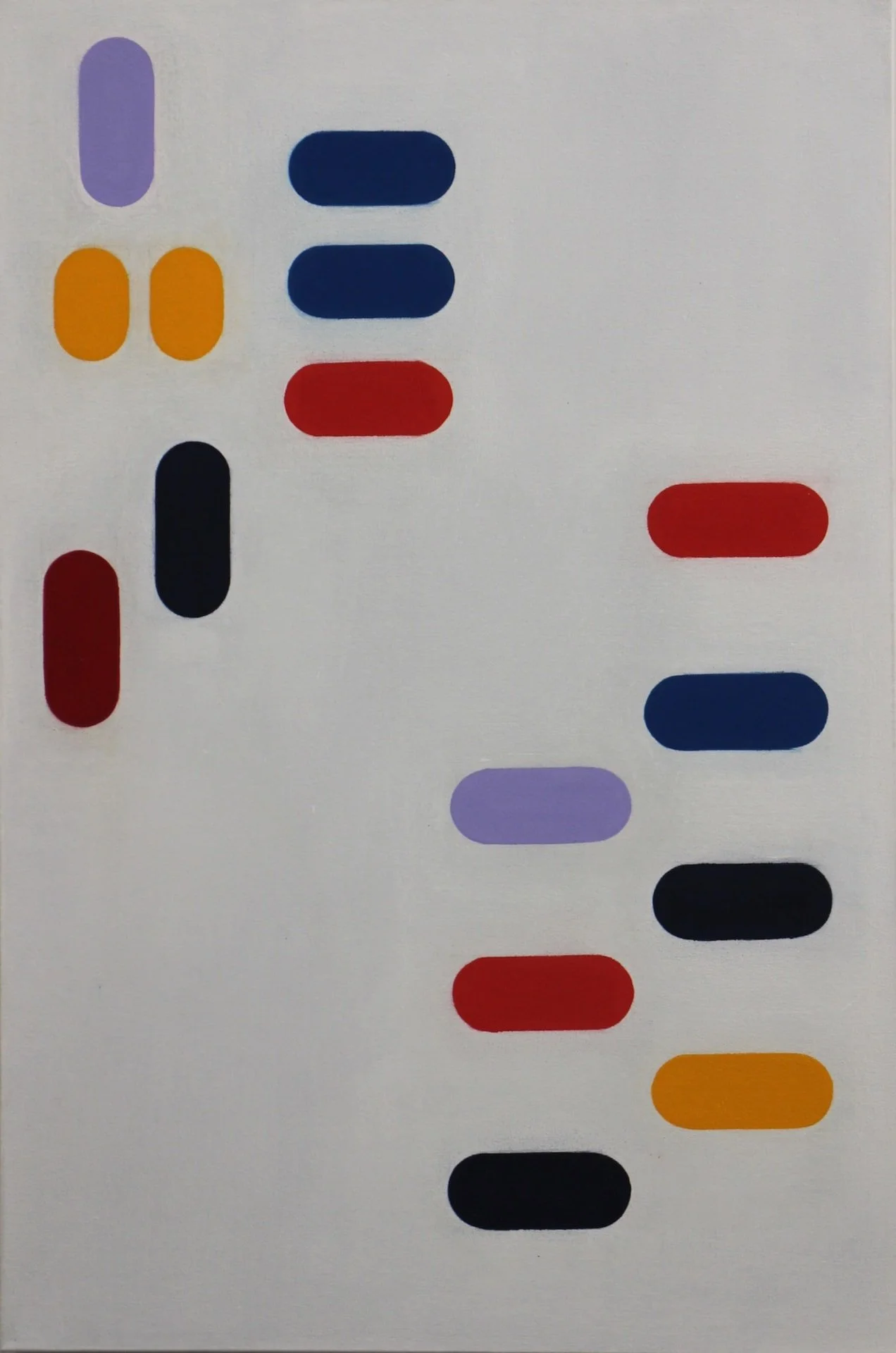
Image: “Office Birthday Party” by Jean Wolff
I think most people go through at least one “early-life crisis.” It’s quite the enjoyable romp if you ignore all the existential dread that comes along with it. To prevent myself from entering one now, I will refrain from arbitrating exactly how early in your life the crisis needs to be before it becomes a “mid-life” affair; but I think if you’re comfortably in front of the half-way mark of your life, you owe it to yourself to try it on for size. It can lead you to fun and interesting places.
I’ve pondered beneath cold covers and under-pressurized showerheads how I could make some sort of semi-permanent mark on this place. I like to come up with ideas that are both anonymous and highly ludicrous, because those are by far the funniest ones to imagine pulling off. Like painting a hundred gnomes onto the same side of a hundred trees in the state lands, or clearing trails that weave and loop through the pine forest and connect only to brambles on either end, or tacking up a wooden sign that reads “Beware Of The Goofus.” Optimally, the act would make only a temporary mark on its environment and be harmless to all man or mink if no one noticed, but confuse the hell out of someone if they did.
In one of my more perplexing episodes, I designed a stencil on a page of printer paper, meticulously carved out the shapes and letters with an x-acto knife, and spray-painted the result onto three bricks. The paper stencil got a bit wet, but—aside from one tiny strip that I had to tape back down—it stayed together. In the end, I gained a bunch of heavy rectangles beset with little pictures of square top hats sitting on square spectacles, all set above the caption “GAZE UPON THIS BRICK YE MIGHTY AND DESPAIR.” Whilst I’m currently on pause from my stenciling adventures, I’m still deep in my Ozymandias phase, and now I’m pissed at myself for getting the line wrong. (It’s “look on,” not “gaze upon.” I will go to my grave annoyed.)
Once you acquire three specialty bricks such as these, holding one in your hand just to look at it (and despair), the big question becomes, “what the hell do I do with this?” Which, to be fair, is very much the proper reaction. You don’t have many options. Throwing it through a window won’t dazzle the blasé masses. It’s also illegal, unless you own the window. Leaving it on the street creates a tripping hazard. Handing it off to someone else is probably a no-go; bricks are more valuable when fresh. I could frame it on my wall, but then I would need some industrial-grade bolts. Really, the only ethical thing you can do with a brick is to get it out of everyone’s way.
So I put it on Equinox.
As a rule, you should not go around leaving things on mountains. Plastic junk will degrade and pollute the ground, and metal and glass can injure passersby. Batteries will explode into caustic sludge and rubber will rot and stink. That being said, there are tiers to these things; leaving a piece of untreated wood, for instance, does no damage (as long as it isn't infested with emerald ash borer). It might even give a few native bugs a nice home. Furthermore, no one with any day plans would notice the artificial, uncut shard of branch nestled among the hundred million natural ones. The same goes for most rocks, as long as you don’t put them in a tree or perform some other doofus behavior.
In this vein, I consider a brick to be, in essence, a very strange rock; the only real difference is that most people would recognize the incongruity of an errant forest brick. And thus, mountainbricking becomes a game of skill to figure out where you can put the thing down without letting anyone get wise to your antics. And that’s the fun of it. It’s hide-and-seek.
I’ve walked up and down the slopes of Equinox Mountain three times. It’s a great little hike over in the southwestern corner of Vermont. And by “little,” I mean it’s a twenty-eight hundred foot vertical ascent up the side of a veritable cliff just to reach an air-conditioned hut next to a slab of pavement full of tourists’ cars. Braver men than I scoff at hills you can drive up, but that doesn’t make the hike any easier on foot. I consider Equinox to be—and I say this as a term of pure endearment—the regional Everest For Unfit People. (Considering my ambitions for Washington—the mountain, I mean—I probably need to work toward becoming one of those mythical fit persons, but this too can wait. I’ve been to the top of Mount Washington by car and by train, and one of these days I’m going to haul myself up there on my own two feet to complete the holy trifecta.)
The day I woke up to climb Equinox for the first time, I had a terrible sore throat. I chocked this up to inhaling smoke from a small fire I had started the day before to burn some dryer lint, but the symptom ended up growing into a full cold a few days later. Picture me that morning: unfit, untrained, two-hundred twenty-five pounds, coming down with an illness, and about to hike up a giant rock in the middle of sweltering July. And, like an idiot, I parked at the bottom instead of the top.
About ten seconds beyond the point where the trail starts getting properly steep, I lamented my existence. I’d brought two bottles of water with me, and by the time I’d crawled a third of the way up the hillside, I’d already downed one of them. At some point I snacked on a banana and some trail-mix, saving my handmade sausage and egg sandwich for the peak; I decided that I didn’t want to make my day any more miserable by attempting an ascent on dubiously cooked pork. I labored over each step, screaming up the slopes at Mach Zero, and through the pummeling beat of my heart I imagined the slow dance of a waltz in three-fourths time, cyclic violins and reverberant horns layered over a pounding drum set to the tempo of my heels. The snippet of hallucinated audio played in my mind over and over, every three steps, and I marveled at the remarkable ability I possessed to find new and interesting ways to go insane.
That hike up Equinox became an excellent study in the art of Not Giving Up. Or maybe the Sunk Cost Fallacy. Depends on how you see it; I go back and forth. I passed a waterfall, a stony cliff, a tree, a tree, a tree, a tree, a tree, and another smaller waterfall. I scrambled up and over logs and staircases made from slabs of the native rock sewn into the ground. I kept myself going by seeking out the distant horizon through the trees, looking down over the rolling scape opposite Manchester and catching glimpses of Stratton and Bromley, and reminding myself that I was gaining some real altitude. Plus, I had just driven two and a half hours to get here, and leaving now would surely seal my fate in the Hall of Losers. Instead, I took frequent breaks; I came to a full stop more than twenty times, sitting down on a rock or a log or the sodden hill and waiting to feel well enough to continue.
A miracle struck two-thirds of the way up the path when it crested a ridge and became about a quarter as steep. There, the trail snakes through the alpine forest, great roots of hemlocks twisting in the shallow pits of moss and needle-beds. Dry pools of level mud dot the scape between stones and the thin decomposing trunks of lost evergreens. At one point I came across the highest-pitched mosquito I’ve ever heard in my life, a tiny foe struggling in the cold, thinning air. Then I saw the fence around the base of a radio tower, and the magic ended.
At the top, I remarked upon two things: the great view, and the fact that I had, indeed, cooked my pork sausage adequately. It was delicious.
There is a side trail that leads to a collection of cleared vantages overlooking the Manchester side of Equinox, which is not particularly visible from the visitor’s center at the summit. Along the trail lies a relatively well-known headstone for a dog named Mr. Barbo, who had been shot and killed by a hunter in 1955. Wiry moss clings to its edges, and hundreds of small stones, brought by hikers, lay on top. When I visited, a few small native flowers and a bough of winterberry had joined the stones.
Opposite the grave, tucked in a dark corner at the edge of the clearing, is a small wooden post. On its face is an old laminated piece of paper. The ink is bleached terribly, going yellow and green, hardly legible anymore. The wood itself is peeling and almost black from some aggressive fungus. The whole thing is covered in speckles of dirt and detritus from the pines and trail around it. The sign is a dedication to another dog named Creamer, who died in 1997 from an unspecified fate.
The difference between the two memorials is stark. Mr. Barbo’s grave stands prominently, a full swath of the forest cleared from around it to bathe its words in sunlight. Its stone face, classically permanent, has been intricately carved with his likeness and epitaph. Creamer’s plaque is itself disintegrating, fundamentally more temporary, almost hiding away from the light.
One of these memorials is showered with love and commemoration. No one seems to notice the other one.
The fact that a piece of paper older than I am has somehow survived as long as it has in that brutal environment, twenty-eight years between its creation and now, is remarkable. I have no idea how much longer it will remain there, or how much longer the words will last. I took a picture of it, a horribly grainy photo snapped from a fundamentally terrible phone that ceased production about as soon as I had obtained one. That picture, too, is ephemeral; I have a new phone, and the downloaded pictures from the old one just sit on my laptop, waiting for the next hard drive failure to pop out of existence.
For the sake of preservation—whatever preservation this document even entails—I have copied the entire dedication below. I wish I could credit the original author of the poem, but I have no idea who they are. Here it is:
“In loving memory of Creamer
1989 – 1997
I came to this sacred place
Where, 40 years ago, the love of man and beast intersected
Boundless, timeless
Across genetic space
Knowing only one language
But spoken by both
Now I stand here where stood another so long ago
Fresh in grief, inconsolable
Here lies Barbo
Loved by master unknown
Whose grief 40 years ago
Strikes again
Like a virulent germ, long-dormant
Now infected
Grief-stricken
Bereft of understanding, I ask
Why nature, inconsonant with the sentiment of man
Uncaring, unthinking,
Turns love to grief
Milk to sour?
Creamer…
The mystery of life deepened now
I burnish your memory daily
Now, carefully
I reach down—one final time
And scoop you up
Your fur against my face
Your tail held
High
***
In tribute to the love that knows no end no time no space
June 28, 1997”
I think we value the permanent over the temporary. Permanence will remain, will still be here the next time we look for it. But I wonder if we devalue the temporary, and in so doing, devalue the memory served. To debate the values of the lives of two things that lived is not to debate the permanence of their gravestones, nor the displays of affection. In time, these things are equal. But then, to forget is also natural. Only that which has been known may be forgotten; and so the memory remains with its own time, come and gone. A commemoration forgotten is a commemoration felt and acknowledged. A dog forgotten is a dog loved. It is, then, perhaps better to forget than to have never known.
The whole brick thing seemed kind of stupid by the time I was hauling it up the mountain on my second ascent of Equinox that autumn. I wasn’t sick for this one, and despite the added weight, I only stopped seven or eight times on the way up. Compared to the memorials on the top of the mountain, I almost felt like my own statement piece would come off as self-aggrandizing and disrespectful, so I decided to put it nowhere near them.
Actually, it ended up being a task in itself to find a suitable hiding spot for my brick. I wanted to put it in a place where nobody would see it unless they strayed off of the path, but at the same time, I wanted to put it as close to the path as possible. The idea of people walking by it, mere feet away and oblivious, energized my process. I couldn’t hide it at the top of the mountain because a parking lot hogged all the space, and I didn’t want to put it too close to the top or bottom either because anyone who found it would just assume I’d driven it there. I needed a hidey hole far enough down the mountain that a prospective discoverer would know I’d hiked up the mountain for it, not just lazily dropped it off.
I chose a hollow in the roots of a hemlock tree about a third of the way down from the top, right around where the path gets steep again. The hole faces away from the trail, looking out to the south over a small slope of forest. I nestled the brick alongside a profoundly green clump of moss, and the rusty red splash gave the scene a tremendous color range. Best of all, the whole invisible thing lay about three feet away from the path; a pristine place to piss if nobody was coming. I had no idea what passersby would think of it, but I chuckled at the idea that someone would turn around and get freaked out for a nanosecond by the bright white text shouting back at them. The people who hike Equinox all have plentifully strong hearts; they can handle it.
The third time I hiked the mountain, the winter had come and gone and the spring had rolled in with enough force to prevent me from freezing to death as I approached the summit. By the time I drew close to the hollow, I wondered if I preferred the idea that the brick had been taken or left, if anyone had noticed it or not. I decided the question was unimportant; I would know soon enough. To ponder something whose answer is imminent is to entertain the false over the real.
It turned out that someone had taken the brick. The hollow lay empty, with just the original moss clump remaining. With this, I decided I was content.
I wonder if a trail custodian saw it, or received some confounding report, and plucked the thing out of the soil to dispose of it in a dumpster somewhere. But I also wonder if whoever found it then kept it, took it home and put it on their shelf, perplexed by the unlikely artifact.
But at the end of the day, it’s just as likely that all the paint flaked off in the winter, and whoever found it only discovered a blank brick with a few flecks of white, illegible matter plastered onto the side. I never weather-tested my creation, so who knows.
The words may be lost, but the brick survives.
And the brick may be lost, but the mountain survives.
For now.
Louis Dufresne is an aspiring author from the woods of northern New England. Most of what he knows about writing has been cannibalized from Stephen King books; he is currently seventy thousand words into a horror novel. You may find him wandering the forests of New Hampshire, where he is known to incur tomfoolery. He holds a degree in Computer Engineering from UMass Lowell, which is hiding in his desk somewhere, gathering dust.
Jean Wolff has had group and solo exhibits in various galleries in New York City and internationally. In addition, she has published 167 works in 114 issues of 62 magazines. Born in Detroit, Michigan, she studied fine arts at the Center for Creative Studies in Detroit and at the University of Michigan in Ann Arbor, receiving a BFA in studio arts. She then attended Hunter College, CUNY in New York, graduating with an MFA in painting and printmaking. She is now part of the artistic community of Westbeth in Manhattan.