Lobster Day
by Jamie Hennick
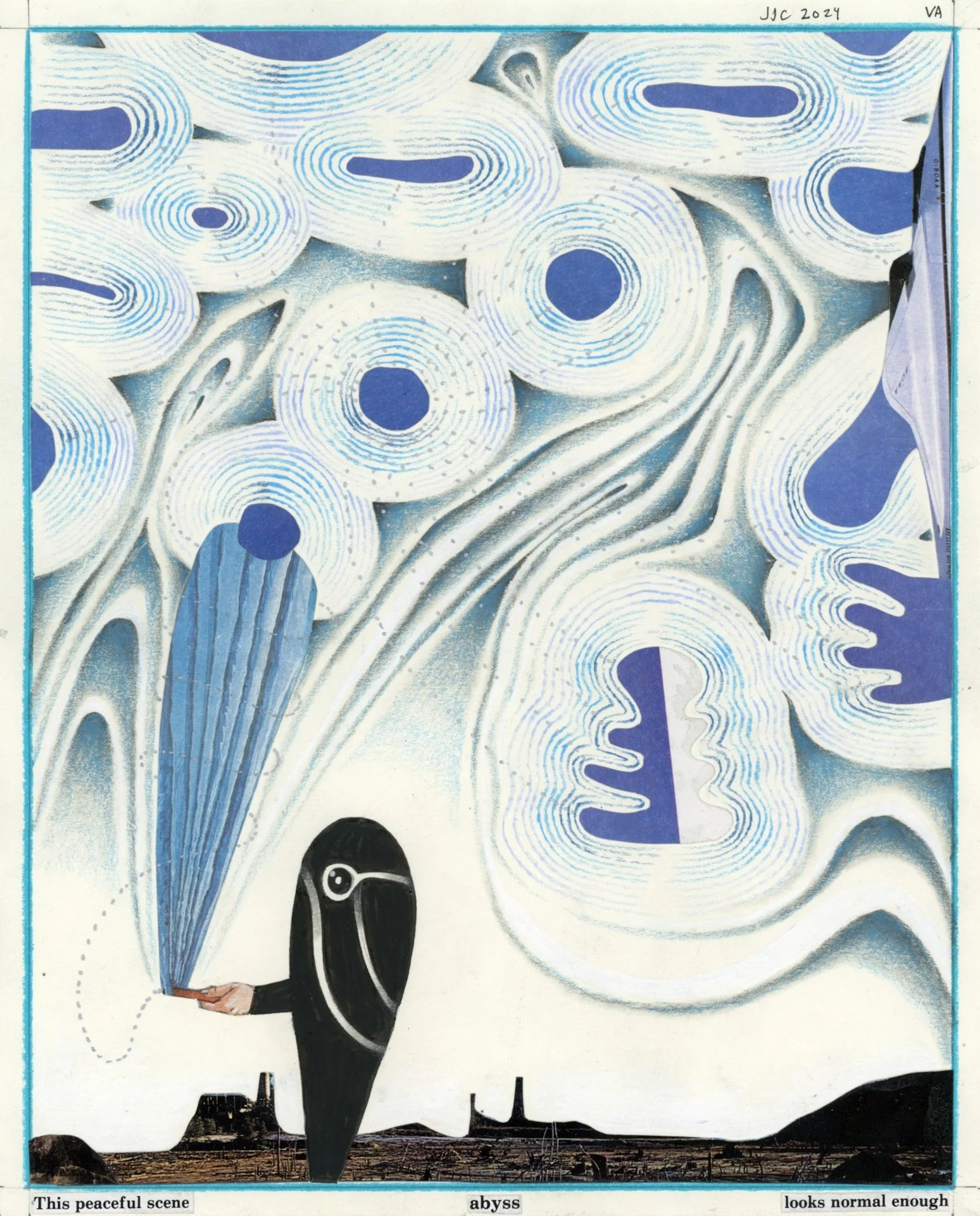
Image: “What We Got” by JJ Cromer
The last time she came home from her dad’s, my daughter told me that my hands had aged, but they were the only part of me that looked old. I consider them often now, turning them around in the sunlight as if observing a new engagement ring. My fingernails, chipped paint from making that carrot cake last night. The grater. Nails short and filed. Buffed. I pinch the slack of the skin on the top of my hand, my hand, my pulsing veins. I find it to be graceful, gently holding in the solid piano playing muscles that run up and down each finger line, up my forearms, my upper arms and into my heartspace. I think of my daughter’s hand when it was small and squishy, how it always found a way inside my palm, would latch on with a gentle squeeze.
The baristas call out every name but my own and I want to leave, but I wait because I need the latte apology for my daughter, who is asleep at home and is likely somehow angry with me still, even in her dreams, after a laborious Friday night of teenage negotiations. I could sit or move or take out my phone, but my stillness is my camouflage – God forbid I catch the eye of Pat from the pharmacy or Jen, my daughter’s friend’s mom, both who are seated nearby and both who will inevitably ask about it. The divorce. How’s it going? They’ll say, pity on their breath. We don’t see you around here much anymore. Anything I can do? Hang in there honey. My other hand boasts the ring finger. The familiar sapphire stone still nests prominently in the valley of skin it has created over the years. I sigh. Turn it over. Wearing it is a foolish habit; maybe it’s time to switch it to my right hand; maybe it’s time to sell it. Maybe my daughter wants it early.
“Ricki, two coffees for Ricki!” Finally, I whisper under my breath.
“Thank you,” I manage. I grab the drinks and weave through the others. When I turn, Pat waves and calls my name and I gesture to her with my full hands, a hello and a goodbye, and emerge into the bright morning. Marine layer still hangs over the pavement, graying the sky with strange twilight light; blue starting to patchwork its way through. Squinting, I see a young woman standing on the pathway directly in front of my car, looking out at the ocean below.
At first, I think she is taking in the sea, but as I approach, I hear her yelling, It’s for him! It’s for him! It’s for him! The waves pound the rocks below, some so forceful that salty spray rockets up to the parking lot, splattering her, dotting the hood of my car. I duck, I blink, I dodge, but the woman does not seem bothered. It’s for him! It’s for him! It’s for him!
When I reach my car, I stop short of opening it, of getting in, of driving away. I look up. And around. There is no one else here.
The woman stands facing the fence, looking out over the dropoff below. Her long dark hair is braided loosely down her back, ocean breeze winnowing through the cracks and loose hairs freeing themselves into a crown of flyaways that dance in the ocean air. She has torn black jeans, a hoodie. No shoes. She could be my daughter’s age, maybe a little older. On her hip, she holds a long flat box made of sturdy, cream colored cardboard, a pearlescent sheen that makes me think Wedding. I put the coffees on the roof of my little car and step forward. I hesitate before finding my voice.
“Are you okay?”
She startles as though I’ve woken her up. When she turns, her hair whips around like a lasso and lands with a thud on her shoulder.
“This. This box,” she says, shaking the box in my direction. Her face is crumpled from crying. My daughter and I call it dirty laundry face – when your face shows all the crumpled up, old emotions. We lock eyes briefly before she turns away. She’s crying; she’s covered in ocean.
“Excuse me?” I ask.
“Why!” she yells. Exasperated, she lets her chin fall to her chest. The rest of her body follows. She folds into herself, landing in a low crouch where she cries over the box in front of her, which now I see is embossed with the logo of the bridal boutique down the street.
“I’m sorry, I don’t understand. Are you… are you all right?” I take a step back and take a panicked sip of my drink before quickly putting it back on top of my car.
“Does it look like it?” she says. Bluntly. Like my daughter. Like the nuance of another’s emotions should be obvious. Not even a mother’s intuition can intuit all this, I’d said to my daughter last night, mid argument. You never listen! she’d responded. Never. So definitive.
“I’m sorry,” I say, “I just meant, well I should have asked, no I should have said that I have a minute if you’d like to talk.” I join her on the path and sit down on the curb in front of my car. She reminds me of my daughter, feeling all of everything all at once, standing at the edge of the world.
Several minutes pass. She cries, I sit. Pat the curb beside me. She wipes away streams of tears with the back of her sweatshirt sleeve. I let my eyes focus and unfocus on the horizon, hoping that the silence will encourage some talking or that she will calm down enough that I would feel comfortable leaving. Reflexively, I spin my engagement ring around and around my finger.
Finally, she says, “It’s always all for him.” She takes deep protracted breaths. She joins me on the curb, placing the box on her outstretched thighs.
“Is there something I can do for you? Someone I can call?”
“Do you want to know what’s in here?” She wipes her nose with her sleeve. I don’t answer, but she continues. “Well, it’s a lobster. It’s a live fucking lobster. I hate lobster.” She stands up and continues to speak towards the ocean. “But it’s what we had at our wedding. I know a lot of brides and grooms don’t eat at their weddings, too busy hugging and dancing and stuff, but I was so hungry...” She inhales deeply, swallows another sob, “and there was nothing on my plate but fucking lobster! I wanted to eat, too!” She shakes the box in my direction. I recoil, press my thumb to my sapphire. “There were some sides, sure, but my God! I was mad. I was so mad.” I wait for more but all she offers is another question: “Do you want to see it?”
Again, I say nothing but she lifts the lid. Sure enough, there is a live lobster. Speckled red, bead eyes, sensing antennae lifting and settling like boom gates, inhaling and exhaling through its scalloped body, its claws held together steadfastly by those thick grocery store elastic bands. It was small enough to fit in this shallow box, which I think likely had been for her veil. The lobster, though small, was cramped in its new quarters, suffocating out of water and quickly losing energy. Its eyes are all pupil, but it looks depressed. Sad. Aware. Once on a family trip to Maine, we’d purchased lobster at the grocery store and brought them home to boil. How do they breathe? My daughter had asked. We’d shown her the gills, explained how they can survive for 24-36 hours out of water, but that it was up to us to make sure to wet them so they wouldn’t die prematurely. I don’t want them to die, she’d said. Let’s save them, let’s save them, let’s save them, she’d begged.
“He wanted it,” she continues. “He’s from the East Coast. He had one of his friends drive here with fresh lobster in his refrigerated van,” she says rolling her eyes. “Across the country. I just couldn’t believe it. Who does that?” She lifts the lid again. “As if we don’t have fresh seafood here. Fucking look around! The ocean is right here. But no. It had to be lobster. And then there I was with nothing to eat.” She looks at me and I raise my eyebrows a bit so she knows I agree with her, that she should have had the food she wanted at her own wedding.
“And now. Look at me. A widow.”
Suddenly and rapidly, she stands, grabs the lobster by the torso with a full fist. I move to stop her, but she’s yelling – I hate you, I hate you, I hate you! – and hurling it over the edge before I can, the lobster revolving over and over itself like a pinwheel on the way down. With its claws still bound together, it lands with a barely audible, barely visible plunk into the sea.
I’m not scared, but I am still. I will not tell my daughter about the lobster. She’ll remember Maine and the kitchen sink full of tap water and their bubbling bodies while they asphyxiated to death. That’s how they pee, we’d told her. The woman continues. I hate you, I hate you, I hate you! Stillness as camouflage. The day cracks open as if in response to her fury, her yells, accelerating the departure of the morning mist, the alchemy of the cacophony – pent up declarations and syncopated breakers dispersing the quiet and making way for the direct heat of the day to unravel all around us, unfurling the same heavy blanket as the day before.
I don’t know where to look or how to feel or whether to call someone for help. She is pitched forward, words spouting, blending with the water’s roar. Over and over and over – I HATE YOU! Under my breath, I join her in measured triplets – I hate you, I hate you, I hate you! – each word with its own beat, its own moment. I imagine saying this straight to his face, the one I’ve looked at every day for the last thirty-two, no thirty-seven years. His pleading blue eyes; his infidelity; his remorse; I’m such a fool; I’m no fool. Our ruin at our daughter’s feet, who says now that she’ll never marry. I love you, I love you, I love you, I love you, I love you, I love you. I’ve said it at least a million times.
Suddenly, she stops. Turns and stares at me. Startled, as if she has jolted from a bad dream. I startle too as I notice the others – early morning walkers and coffee fetchers and beach goers all stationed like seagulls throughout the lot, staring at us with worry. Pat is across the lot – I look away quickly to ensure we do not make eye contact. The woman wraps her arms around her stomach, breathing deeply.
“I’m so sorry – I’m not usually like this. This, this day, it’s not usually like this.” She kicks the veil box weakly. “I miss him. He was not well. I should have known – I convinced myself I loved him. No. I did love him. But he was not well, simply put. It was not real. It feels like it was never real.”
I’m fumbling around with my ring again. I don’t know exactly what she means, but I know what she means. We’d thrown the dead lobsters back in the ocean. She puts her hands on top of her head and shuffles in place, slowing her breath, noticing the others all around. We went out instead that night, clam chowders and hot dogs. My daughter must be waking up by now. Maybe she is walking around the new apartment, investigating its nooks and crannies for herself without me there, running her hands over the familiar furniture, the plants, going into the yard to the lemon tree, plucking a fruit, smelling its skin, feeling free by feeling alone, feeling scared to be alone, thinking the apartment is weird, will always be weird, that it isn’t home, it will never be home. Maybe she is wondering where I am, calling my name only for the dog to come arfing, sitting on the couch, exasperated by the lack of sweet cereal, calling her friends, telling them that she’s starving, watching TV, wandering in the yard, calling my name, wishing she had her license, or a bike, or both, calling her dad to pick her up early, reporting my neglect, my incompetence, my absence and his response – I know, honey. Or maybe she’s still asleep.
“Do you feel better now?”
“Yes,” she says.
“I understand,” I say. “Sometimes, we need a release.”
“It’s the time of year, it just gets to me – I wake up one morning and know that it’s Lobster Day. Always around the day of our anniversary. Not the anniversary – I hate that people call that an anniversary, anyways. I want our anniversary to be a celebration. With lobster, like he liked,” she says, gesturing out to the waves, to the lobster. His bound claws. We’d eloped. Steak dinner with you after, kid, we always told our daughter, who was kind of there.
“Do you need anything? I do have to get going,” I say, gesturing to the coffees on the top of my car.
“I’m married again, you know. My husband’s waiting over there in the car,” she says, pointing vaguely beyond the cluster of shops. “We had breakfast for dinner at our wedding.”
I recoil at the thought of her new husband, wonder why he wasn’t here with her, why he would watch her have a breakdown with a stranger. She could be my daughter’s age, but she’s not. My daughter’s too young to be married. Too young to be married for a second time. I hope she’s picking lemons; I really have to go. I’m looking around the lot for her husband, but there is no one left; the lot is empty. What is this but performance. Is she even a widow if she’s remarried? Mom, not your business, I can hear my daughter saying.
Forcing a weak smile, I simply say, “I’m really glad to hear that.”
“I’m really sorry, really. You caught me at a bad time.”
“Totally okay, I just want to know that you are okay before I take off,” I say.
A ringtone emanates from the front pocket of her hoodie. She holds up a hand and says, “Sorry, it’s my mom! Hello? Pause. Yeah, I’m almost done. Pause. I’ll be back soon. Pause.” I check my phone. No calls, just texts. – Where r u? – No cereal. – No milk. – Neighbor keeps waving to me. – Smells better than dad’s here. – Pathos looks good on bookshelf. The woman holds up one finger – Wait – and continues talking to her mother. “Want anything while I’m out? Pause. Ok, cool. Pause. I have my bike but I’ll pick up what I can fit in the basket. Pause. Pause. Ok, bye.”
And then she’s scrambling to pick up the box and its lid and she’s saying I gotta go, thanks again, thank you for stopping and I’m insisting that it was nothing and she’s insisting that it was something.
She starts down the path, earth crunching beneath her bare feet as she walks away. I see no bike nearby. She pauses and turns to me, where I am frozen in place. “No one ever stops,” she says, “no one ever does.”
“Happy to help,” I say, putting my idle hands in my jacket pockets.
“It helped a lot!” she calls over her shoulder, sounding lighter and maybe on the verge of a song, but I don’t think I believe her – all I can hear is what this all started with, with I hate him, I hate him, I hate him! The echoes of her voice seem to reverberate still across the lot. Like a church bell, like a knell. I can hear, too, the rotational whoosh of the lobster. Its claws still bound. Plunk. Gone. My husband’s over there, she’d said, pointing to no one. No one is here. Thumb presses sapphire, ring goes around. Again and again, and again and again. Intervening is the other hand, pulling it from its skin folds. Then, it is clenched in a tightened fist, its sharp edges making new shapes. Clammy hand. Next could be air. Then sky, sky, sky. Then ocean. Then nowhere. Goodbye, goodbye, goodbye. The ring would be nowhere; the ring would be there. Let’s save them, let’s save them, let’s save them! I hate him; I pocket the ring.
Sun on my face; fog rapidly dissipating; sun awakens earth; sun awakens me. Thumb on my bare finger, bare knuckle, bare nail. The ring’s former valley smooth and expanding. Ring in my pocket. Let’s save them! I close my eyes. Coffee. The lot smells like coffee, the air smells like sea. The lattes will need reheating; I should get more treats; I should go right home. Another car crunches over the gravel. I open my eyes. Then, a group of cyclists slow and dismount, having reached their ride’s terminus. It’s usually quiet in this little shopping center. Another car. The girl is gone. A wave crashes over the fence.
Jamie Hennick writes from the wilds of western Massachusetts where she frequents the region's forests and rivers and bookstores. She writes frequently about trees and teeth and is working on a collection of short fiction that feature both. Jamie earned her MFA at American University, along with the Myra Sklarew Award for remarkable originality in a prose thesis. Her work can be found in Bridge Eight, The Palisades Review, Grace & Gravity and The Colorado Review (online) and at jamiehennick.com. Her favorite aquatic flower is the spatterdock.
JJ Cromer is a self-taught artist from Virginia. His work is in several public collections, including the American Visionary Art Museum, the Intuit Center of Outsider Art, the High Museum of Art, and the Taubman Museum of Art. He and his family live on a farm in central Appalachia, where they have kept chickens, ducks, geese, and bees. www.jjcromer.com IG: @jjcromer