Multitude of Hosts
by Lana Spendl
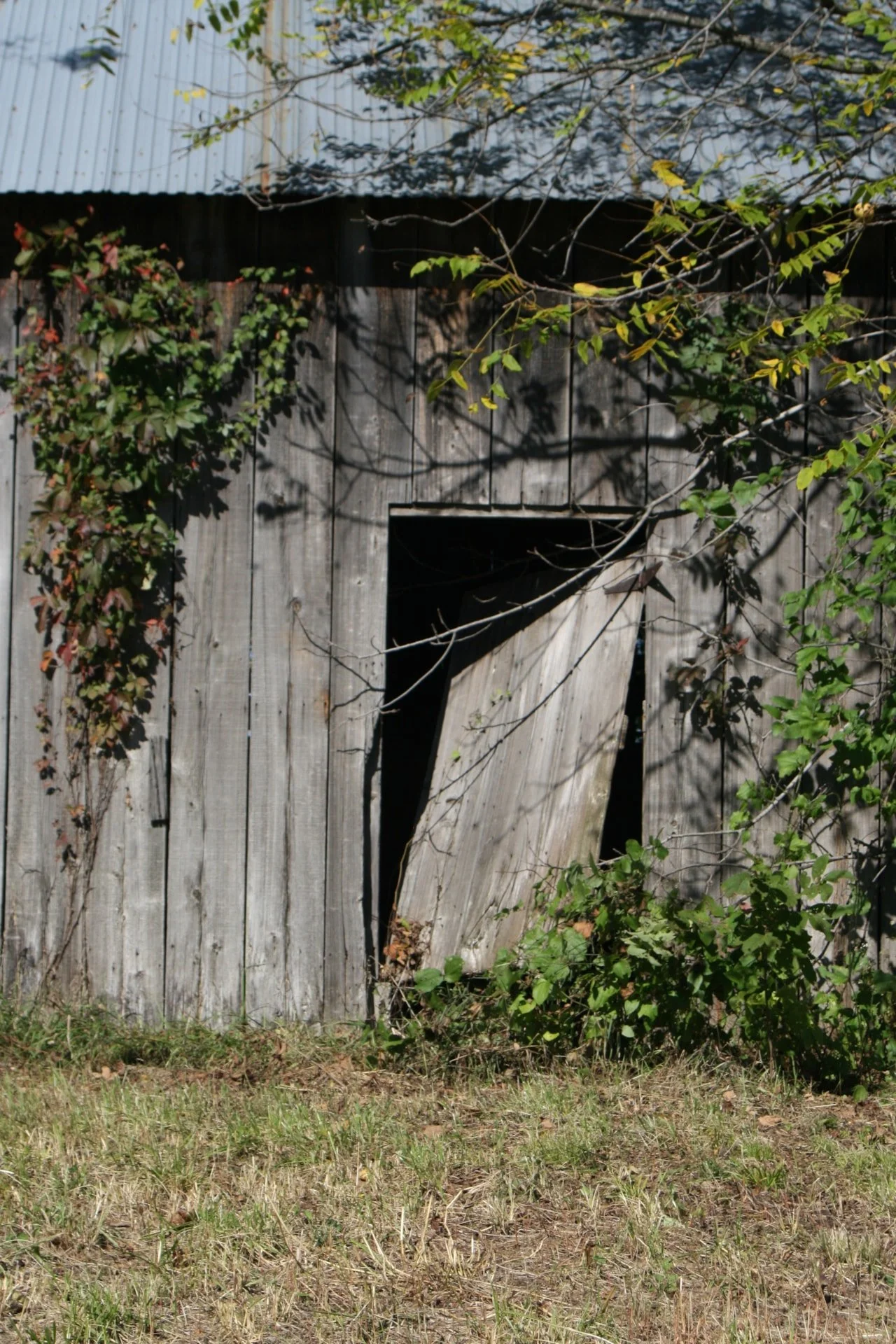
Image: “Verdant Recovery: Overgrown Missouri Barn, I-70” by Michael Roberts
A thick blue-white candle sits by my side when I write. I light it as I’m about to get started and blow it out after I’m done, my eyes bleary from staring into the screen for so long. The tunnel at its center already reaches halfway down.
Although I don’t remember when I started this candle, I like to think its original spark coincided with the beginning of the short story I’m writing now. The emptiness at its center therefore contains everything from my initial character sketches to their subsequent evolutions on the page. That argument my two characters had in the car. His turn of the head, in tense silence, to the field outside the passenger-side window.
Within that hole at the candle’s center are also my obsessive workings and reworkings of paragraphs. My em-dashes-turned-commas (I use em dashes too much) and my corrected typos (our often replacing out).
At a reading I attended last month, an essayist exploring the nature of holes mentioned that the philosophical term for what surrounds a hole is a host. A hole, of course, cannot exist without its host. Without the wax walls, in this case—which are scented like no ocean breeze I’ve smelled before—the hole that contains my story would not be its own entity.
In the Bosnian culture of my birth, known for hosting, the host holds space for the guest in every way, offering the overnight visitor their own bed even, since it’s the best one in the house. Does the candle hold my story with the same care? Perhaps it does more snugly, more perfectly, since with every millisecond it sweats and drips off wax to accommodate the story’s growing shape. Perhaps every culture in the world falls short compared to this (this admission hurts my Bosnian roots).
When we left Bosnia during the war for my second culture of Spain, I encountered a different kind of host. A sacred host. A host offered to the line of faithful at the head of the church. This flat, round white host represented a total sacrifice for others, a complete self-gift. My classmates went up as I waited behind. Even though I had started believing in their god at that time, I could not go up in my white blouse with its wide collar because I had never been baptized, nor ever gone to confession.
But how I’d dream of what was whispered in those confessionals. All that darkness and heavy wood. And how I’d daydream, too, of the heaven our gruff priest described into his mic, pausing now and then at the high-pitched feedback that echoed through the church. In unison we’d recite, Padre nuestro que estás en los cielos, our voices reaching the domed ceilings and the choir balcony where generations of monks had sat.
Perhaps the church itself was the host in this case—its walls and floors and ceiling and our very bodies within it—to the negative space of the air through which our voices vibrated and ricocheted.
At my desk now, by my candle, in my third culture of the States, I am the host of memories—landscapes and churches and mosques and the low rooftops of the Old Town part of Sarajevo, my original hometown.
When I was six or seven, Radio Television Bosnia and Hercegovina held a poetry contest for kids. They called for submissions about Sarajevo, and the prize was a visit, with your family, to their headquarters. I imagined walking through their doors with my parents as professionals in suits stumbled to take us around. So I sat at my dad’s desk, by the lace curtains, and applied myself in my careful cursive. I composed in pink pen praises of Sarajevo’s neighborhoods, streets, and schools, and I mentioned rabbits (not a known quantity within city limits), because it was the only way to complete a rhyme. And back then, I was sure, poems had to rhyme.
Another memory comes in. In this third culture of the States, my middle school teacher assigned us the homework of writing a poem about a favorite animal. I applied myself that night with my dad, although we were both still learning English, and we put together four quatrains. The poems were to be read to the class. Mine was about a lion. And when I finished reading the next day, my eyes flew to my teacher—no one else in the room existed—and I saw worry in her creased brow.
I am like the wax walls now, hosting rivulets of pain and pleasure and color and light. That image from my Bosnian childhood of my mother’s aunt, in a stone-walled garden, reading my mother’s future from her empty coffee cup (after you finish your coffee, you turn the cup over to drain, and the grains make patterns against the porcelain). Her aunt told my mother she would go on a great, big voyage. Against the stone walls of that garden, pink roses grew in buds. The kind my mother would call back for decades, whenever we passed roses in the States. It was the initial form of rose she knew, her Platonic ideal, that to which all subsequent iterations were compared.
When one opens a memory, it seems, another one spills in fast. As if they’re all waiting somewhere out there behind a great memory dam—endless images and people and scents of lamb on the stove and old hands shuffling cards—just waiting to flow in. Waiting to be hosted.
Recently, I attended a lecture about a supermassive black hole at the center of our galaxy, and halfway through, I looked around at the sea of heads in the auditorium. I marveled at how tiny we were, here, on our little planet. How tiny, and yet how much we each can host.
Lana Spendl’s stories, poems, and essays have appeared in The Threepenny Review, World Literature Today, The Rumpus, New Ohio Review, and other journals. She is the author of a chapbook of fiction and serves on staff at Crab Creek Review. Her childhood was divided between Bosnia and Spain prior to her immigration to the States. Read more of her work at lanaspendl.com/writing.
Michael C. Roberts is a mostly retired pediatric psychologist seeking creativity through photography. His film and digital photographs have appeared in American Psychologist, Health Psychology, The Canary, Images Arizona, Burningword, The Storms, The Healing Muse, The Alchemy Spoon, FERAL, and elsewhere. His book of photographs, Imaging the World with Plastic Cameras: Diana and Holga, is available on amazon.com