Eggs
by Shayne Langford
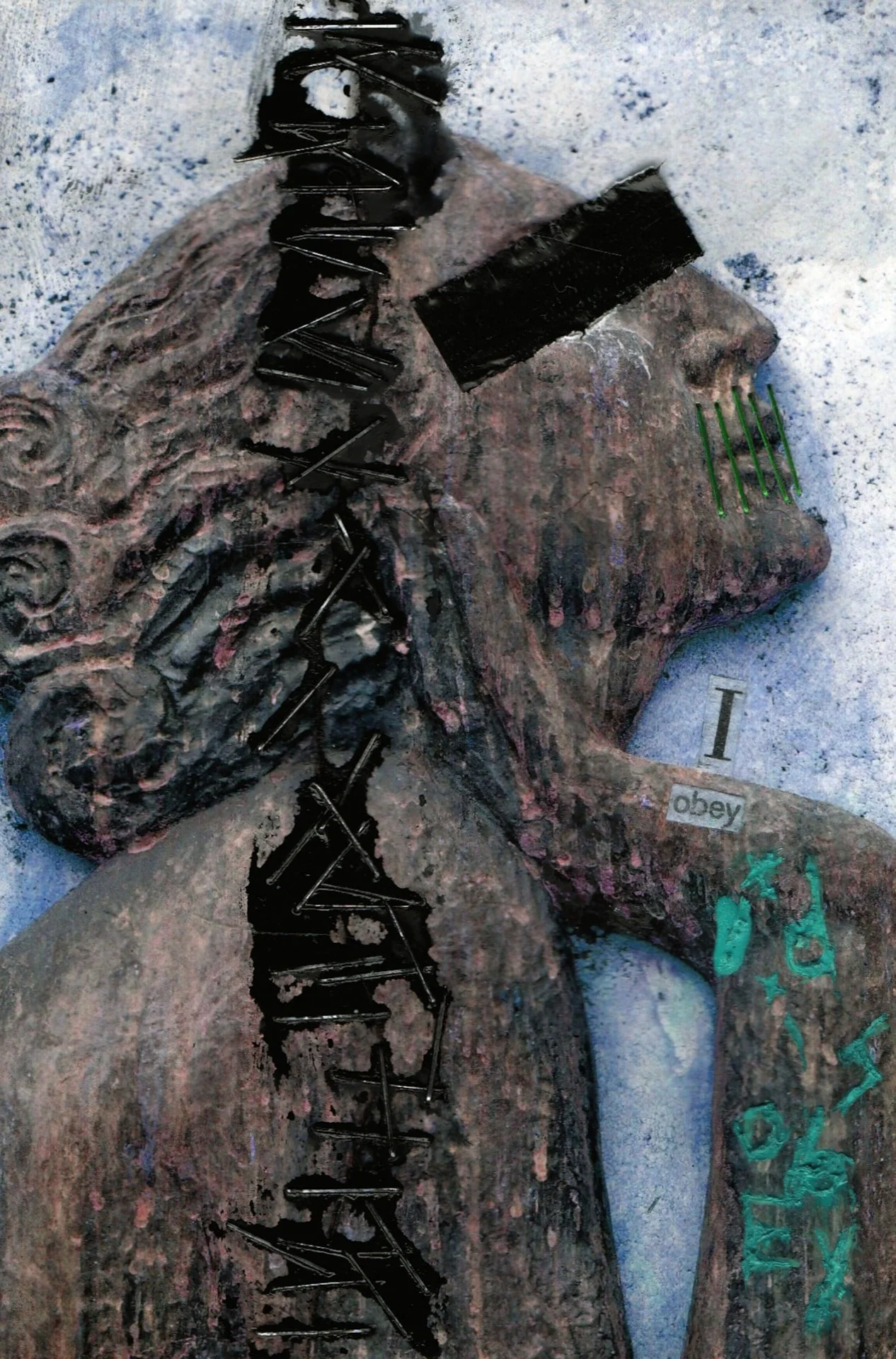
Image: “i Obey. i Disobey” by Brett Stout
Every summer, there was a blood-trail running from the bridge over the river to the shed in Danny’s backyard. It showed up in June and remained through September, when his father hunted in the woods on the other side of the river. He was laid off from the mill every winter, so he’d stock the shed for the cold months when the family ran out of money. That was the only way they made it through without starving.
Every few days, Danny’s father would cross the bridge and hike into the woods before dawn, and in the evenings—sometimes the afternoons, if his father had been lucky—Danny would watch him drag the gutted body of some animal or other through the yard and into the shed. It would leak blood all over the grass and all over the bridge. He’d always wanted to hunt, to help drag the animal back, but his father said he was too young. And one of Danny’s legs was shorter than the other—which caused him to limp when he walked—so his father said he would make too much noise, scare the animals away. But Danny would at least be able to go out to the shed and watch his father cut whatever he’d killed into pieces with a machete and get it ready for curing, and then he’d help hang the meat from the rafters. They had all sorts of animals in there—elk, deer, boar, moose. Sometimes Danny would stand in the shed and look at all the hanging animals when he ran out of stuff to do out in the woods. He would poke them with sticks. He would use them as punching bags, if he felt like it. He’d even throw darts at them—the type of thing a country boy does when he’s bored.
Danny hated eating that meat all winter long. In the summer, after a hunt, his mother would cook a meal straight away, hot and fresh. All the meat tasted different when it hadn’t been frozen for months on end. He could tell elk from moose, deer from boar. But in winter it all started to taste the same. His mother stopped cooking it for him, except in the evenings, to save on the gas bill. If he wanted any lunch at school, Danny would have to go out to the shed in the morning and take the machete to one of the hanging pieces of meat. Then he’d pack it in a Ziplock and stuff it in his backpack. Around lunchtime, or on his way home, he’d take out his pocketknife and peel little pieces off the chunk and eat them. God, they all tasted the same. Salty and dry. After a while, the thought of eating would make him feel sick and he’d struggle to get the stuff down. The meat wouldn’t even warm his belly like it would in summer since it was half frozen, which made him feel cold inside.
One morning, a big storm rolled through and dumped snow on the mountains, so school was canceled. Danny slept in and woke up hungry. Obviously, he didn’t want a cold meal for breakfast. He felt like having some eggs, maybe, and some bacon. He was fed up with all the meat in the shed. He walked out of his room and into the kitchen. His mother was reading at the table with a cup of cinnamon tea, something she saved for storm days in winter, and Danny thought that was a weird thing for a person to drink. He tried it a few times when she wasn’t looking, and it tasted terrible, like something was attacking the back of his throat.
Danny sat down across from his mother and asked if she could make him some scrambled eggs.
“No,” his mother said. “We don’t have any right now, you know that. I don’t know where we’d get them, either. We’d probably have to go into town, or somewhere. Why don’t you go and grab us something from the shed. Have you tried that pork? Must be the best pig we’ve had since you were born. Get us some of that, hun.”
“What about Mr. Ames?” Danny said.
“What,” his mother said. “What about him?”
“Mr. Ames’s got some chickens. I’ll betcha he’d give us a few eggs if we asked him for it.”
“No,” she said. “We don’t need any handouts. We’ve got enough meat this year—more than enough. Just go grab us some pork, hun. A leg, how about getting one of those? Please. Don’t forget the hot water,” his mother said.
Danny put on his jacket and snow pants and walked out the sliding door. It was snowing so hard he couldn’t see the shed from his porch, but he started walking toward where he thought it might be. Flakes hit his face and ears and melted, and then froze to his skin and the hair that fell down to his shoulders. With each step, the powder went up to his shin and he had trouble bringing his right leg—the gimp leg—out of the deep snow. It had grown weak over the years while his dominant leg built up muscle, so the weak one tired easier. But both his legs were pretty sore by the time he got out to the shed. He thought about a story his father had read him about a man with a dog—the man had walked into the woods when he shouldn’t have and froze to death. He had gotten so scared of dying that he tried to kill his own dog at one point, just to stay alive. But the dog ran away and left the man—who’d stepped in a puddle and accidently put out his fire—to die. Danny thought it might be cold enough for him to freeze to death, if he fell and got buried in snow.
When he got to the shed, he tried to turn the numbers on the padlock. It was frozen so he dumped the hot water on it and tossed the glass in the snow. Then he turned the numbers before the water froze again. His walked in, picked up the machete from the table and stood below all the hanging meats. He imagined his father dragging them through the woods in the summer, when the meat was still warm and not salted and frozen. He thought of a fried piece of meat fresh off the stove, and his mouth watered. Then he walked to the back corner of the shed where all the different legs were hanging. He grabbed a rope and cut one down. He held it against his chest and it made his fingers colder. His hands began to shake so much that he put it down and began to breathe into them. After they were warm, he pulled his sleeve down over his hand and held the leg by the ankle while he put the lock back on. He walked back to the house, set the piece on the kitchen counter and went to find his mother. She was watching the news with his father in the living room.
“Gonna be more jobs in town once he’s in office, I’ll tell ya that much,” his father was saying. “That’s what he’s been tellin’ us, anyway. Says he’s gonna fix things—make stuff great again. That’ll be nice.”
His mother said, “I wouldn’t count on it. I have a feeling not much is gonna change around here. I mean, think about it. When was the last time something changed? Last thing I remember is Billy’s house burning down. You remember that? If things don’t start getting better, we won’t be living indoors either, hun. We’re barely getting through as it is.”
“Nah,” his father said. “This guy—he’s gonna change stuff. I don’t give a damn if he says some things people don’t like. He’s gonna get me a job—a real one. Full time. I’m tired of cuttin’ wood all day. Sick of it. I need somethin’ better.”
“All I’m saying is don’t get too excited,” she said.
“Maybe a job at a car dealership, or somethin’. Or—”
“I’m serious. Don’t count on it.”
“Or, or maybe somethin’ to do with food. I always liked cookin’.”
“No, you don’t,” his mother said. “You don’t ever cook. I don’t think I’ve seen you in the kitchen even once. I’m always the one in there, getting oil all over me and burning myself, scrubbing the grease off those pans. You really feel it in your arms after a while.”
“You complainin’?” his father said. He shifted in his seat and the muscles in his arms clenched. “You wanna drag a goddamn moose through the woods by yourself? Be my guest. Hell, I’ll even give you a couple lessons on technique so you don’t hurt yourself. And I’ll sit inside with an apron on all day while you’re out there gettin’ the food in summer. What a life that’d be.”
Danny said, “I put the leg on the counter.” He was tired of waiting for a pause in their conversation. His mother and father looked up at him. “I was thinking,” he said. “Maybe we wouldn’t have to ask Mr. Ames if we could have some eggs. Maybe I could just hop the fence and get in his coop. That’d be nice, to eat somethin’ warm.”
Danny watched his mother’s eyes cut in his father’s direction. His eyebrows were pinched tight in the middle, and his mouth hung open so Danny could see stains from chewing tobacco.
“That’s stealing, hun,” Danny’s mother said, looking back his way.
“I didn’t raise no thief,” his father said through his teeth. “Dammit boy, where you get off thinkin’ that way? Who told you it’s okay to steal, huh?” He looked to Danny’s mother. “Is he watchin’ those shows again—the ones with them meth dealers? I told you not to let him watch that trash. Gets it too mixed up with real life and he’ll start thinkin’ what’s wrong is right. He don’t need that in his head.”
“No,” Danny said. “I haven’t watched any of that.”
“He hasn’t, really,” his mother said, and kept her eyes right on him.
“I’m just gettin’ tired of eatin’ this same food all the time,” Danny said. “It’s freezin’ cold and it makes my stomach hurt. I just want somethin’ warm for once. And I’m sure Mr. Ames won’t mind too much. I’ll bet he’s got twenty-five hens in that coop. Who cares if we take a few eggs? He won’t even know the difference.”
“That’s thievery,” his father said. “You better not be stealin’ stuff, or I’ll tan your hide.” He paused and looked from Danny to his mother. “No one appreciates the meat around here, huh? Fine. Fine. You get it yourself next year then, the both of you. Or maybe Danny can steal us some.” He looked his mother straight in the eyes, and Danny felt nervous somewhere deep in him. “Who raised this boy to be a thief, dammit? Sure as hell wasn’t me who did it.”
“He hasn’t stolen anything,” his mother said. Then she looked at Danny. “Why don’t you go out and play for a bit?”
“It’s snowing,” he said. “Plus, I’m hungry. I want some eggs.”
“Dammit, boy,” his father said. “No eggs. You hear me? We’re not gettin’ any eggs, ever. Not even if we can afford it. So lose that thought. ”
Something came up in Danny’s throat and his eyes grew cloudy. He felt like he’d been drinking his mother’s cinnamon tea.
“Go out and play,” his mother said. “I’ll cut that leg up in a bit. Just go out for now.”
Danny opened the slider and went outside. His snow clothes were piled by the welcome mat on the back porch where he’d left them. He slipped them back on over his camo pants and flannel. Then he limped out through the snow in the direction of the shed, though he still couldn’t see it.
The last time his mother had cooked eggs, it was summer, when they’d had a little extra money. His mother made a trip into town for new bedsheets. She brought enough eggs home for a week’s worth of breakfast. He ate like a king that week. She’d even mixed in some fresh pork from one of the hunts and made omelettes, which didn’t happen often. Right then, he imagined rolling a mouthful of scrambled eggs around with his tongue until they fell apart in his mouth. He thought of that warm feeling when they fell down his throat and into his stomach, and being full all afternoon until dinner. Then, for a moment, he imagined a nice venison steak, cut fresh and fried for dinner. But soon his head went back to eggs.
When he got to the shed, the lock was frozen again and he hadn’t grabbed hot water on his way out. So he dug a loogie from the back of his throat and spit it onto the numbers. He tried to turn them but they were still frozen. He spit on the lock again. Then he breathed on the lock for a moment, spun the numbers and pulled it open. He grabbed the machete and felt the blade, how sharp it was. Danny looked at all the hanging pieces of animals, dozens of them. He remembered tying the ropes so his father could pull them up into the rafters when they were still fresh. He breathed deep and smelled salt and flesh in the cold air, which made him feel sick to his stomach.
He walked over to the ribs of some animal—he couldn’t tell what kind—and took the blade to it. He cut off a chunk and took out his pocket knife. He peeled a piece off and put it in his mouth. It was so cold it hurt his teeth. He didn’t understand how so many animals could taste the same. He knew it wasn’t always like that, not when he was younger. Every animal had seemed to have something unique about it. But now—nothing! He felt like he was going to puke if he held the meat in his mouth any longer. He spit it onto the floor and smeared it with the toe of his old Danners, then threw the rest of the chunk against the wall. He dug out a loogie and spit it on the hanging ribs and punched them. He hit them with the machete and pieces of meat went flying.
On one of the swings, he missed and hit the rope and what was left of the ribs fell to the floor, taking some of the wood from the ceiling down with it. He felt sweat in his armpits and on his scalp, and his knees began to shake beneath his snowpants. He stood still for a moment, looking at the meat scattered across the room and the bits of wood on the floor.
“Oh God,” he said.
He knew his father would see the wasted meat and Danny understood what would come after that. He gathered up as many chunks as he could find, taking his jacket off and using it to hold all the meat. He limped around the shed picking up as much as he could, until his jacket was so heavy that he had to drag it behind him. He emptied it over the ribs, stuffing the chest cavity full of meat. He put his jacket back on and smelled the salt on the inside of the lining. But even with the extra layer he was still cold. He thought about the man who tried to kill his dog to stay warm and fresh tears fell down his face. He grabbed the rope attached to the ribs and dragged it out the door, then put the lock back on the latch and snapped it shut. He pulled the rope over his shoulder and dragged the meat toward the river like a sled over the surface of the snow, which was still fresh and buried his boots with each step, and he struggled to pick his gimp leg all the way up as he went.
By the time Danny reached the river, the snot had frozen to his nostrils and his eyes stung. He couldn’t feel his ears and there were ice particles in his lashes. His teeth were chattering. His hands were shaking and they were red from gripping the rope. He brought the ribs to the bank of the stream and kicked it into the water with the bottom of his boot. Some chunks of meat fell out. He thought the crawdads might eat those and get rid of the evidence for him. The rest of the meat, held afloat by the rib bones, went downstream with the current. Danny thought maybe a homeless person would find it, or maybe a fox would have its way with it—or a cougar. He thought they might be thankful to have a meal in winter, when it was so cold out. He couldn’t imagine they did much hunting in the snow. He felt good about throwing the meat in the water.
His stomach growled as if it were angry, like his father did sometimes when he’d been drinking. He remembered the leg on the counter. He imagined his mother had cut the meat up by now. There was no way he’d be able to eat it. Plus, he wasn’t sure he was allowed back in yet. He figured he’d stay outside until his father went out to check his ice fishing hut on the lake. He started heading back toward the shed, running this time to keep warm.
He ran and ran—or hobbled as fast as he could, at least—and his snow pants were pulled up by the snow, so ice got in his boots. The ice melted under the warmth of his feet and his socks grew moist. He just wanted to get indoors and eat something. He made it to his shed and ran around the back of it, to the fence between his yard and Mr. Ames’s. He grabbed the top of the fence and hoisted himself up, one knee at a time. He crouched at the top, holding on to the edge and looking down into the yard. The snow was deep below him and he was afraid he might sink into it and get stuck if he landed on his feet. Then he’d be in big trouble. He might die, like that man.
He jumped off the top of the fence and rolled in the air as to land on his back and keep from sinking. He got up and snow fell from his collar and into his shirt and melted on his back. He kept hobbling along the fenceline, careful to make quick footfalls so he didn’t sink.
He continued along the fenceline until he could see chicken wire somewhere off in the snow. When he reached the coop, he took out his pocketknife and chipped ice from the gate handle, then jiggled it until it fell off. He walked up to the insulated part of the coop that was shaped like a small house. It had a ramp with an opening just big enough for the chickens to slip through, and a window above that. Next to the ramp was Mr. Ames’s door. He chipped the ice off that handle too. He jiggled it, but it didn’t move. He bent over and cupped his hands around it and breathed into his hands, which were now red and swollen. Then he stuck the knife in the crevice behind the handle and broke off more ice. When he opened the door, the chickens jumped from their roosts. They started squawking and clucking. Danny shut the door behind him. The coop was warmer than his house, and he thought maybe the snot would melt from his nostrils.
“Hey,” Danny said. “Hello chickens, hello.” He often heard Mr. Ames talking to the birds when he fed them and tried to mimic what he’d heard the old man say. “Good chickens,” he said. “Nice chickens.”
He looked along the top of the roost for the hens that hadn’t moved. He knew if they didn’t move that they were keeping their eggs warm. He found one—a white and black hen with an orange beak and red skin around her eyes—and picked her up. The hen clucked and moved her head back and forth, and Danny felt her feet tense against his chest.
“Hey, girl,” Danny said. “Hey, that’s a good girl. That’s alright. Hush now.”
He put the hen down on the floor and she scampered away. Then he reached up into the nest and felt two eggs in his hand. He put one in his pocket and cracked the other on the edge of the roost. He held it over his mouth and opened it. The slimy stuff inside ran down his gullet and into his stomach. It was warm from the bottom of the hen and he could feel it land in his empty belly. He took the other from his pocket and ate it the same way. He moved to another hen, and another. He swallowed nine eggs before getting his fill. He was tired from his run through the snow and he climbed up on the coop between a few hens to lie down. They clucked.
“Hey, girls,” he said. “Hey, girls. It’s okay. I just need to warm up for a bit. It’s okay. I won’t hurt you.”
He shut his eyes and imagined a hot plate of eggs in the summer. He imagined his father dragging dead animals through the backyard, and the blood trail after it had dried in the sun and hardened over the grass. After a time, the hens stopped clucking and moved closer. He snuggled between them and used his hands for a pillow. He thought he might like to stay there a while, maybe all the way to summer, if he could, when the meat would be fresh again. He knew the chickens would keep him warm, and that the eggs would. And he felt that he would be safe there, which was all that should matter to anyone.
Shayne Langford is a writer from rural Northern California. He received an MFA in Creative Writing from UC Davis, where he now teaches in the English Department, alongside serving as a fiction editor for the environmental arts literary journal Terrain.org.
Brett Stout is an artist and writer originally from Atlanta, Georgia. He is a high school dropout and former construction worker turned college graduate and paramedic. His work has appeared in a vast range of diverse media, such as art and literature publications by NYU and Penn.