Second-Hand Cheese
by Itto Outini
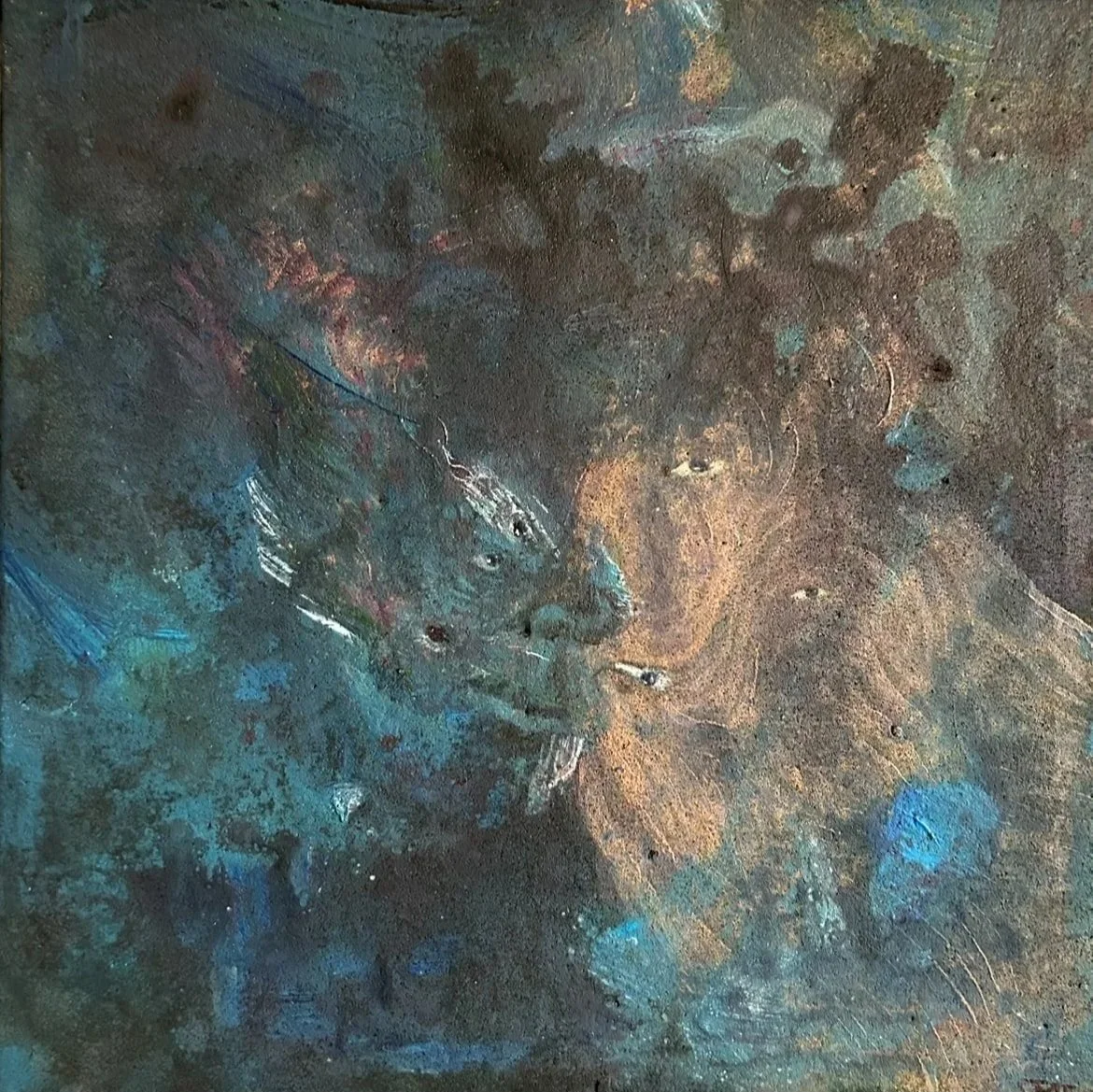
Image: “I See Things In The Dark (They See Me Too)” by Jamie Harrison
TV is not my go-to medium. I read. I haven’t binged a show in years. But I do remember the last time I did. It was Silicon Valley.
Twice during the HBO sitcom’s six seasons, I became uncharacteristically emotional: first when the protagonists discover that they’re constitutionally incapable of producing substandard work, even when they conspire to do exactly that to spite an exploitative employer; and then again at the end of the series, when, recognizing the destructive potential of the product they’ve created, they resolve to destroy it, along with the company they’ve spent six years building.
“Are you all right?” my husband asked when the final episode ended. He’d understood and even shared my reaction to the failure-to-achieve-mediocrity arc, but now he was nonplussed.
“But why did they do that?” I burst out. “They put all that work in—for what? Just to destroy it? Why? That’s not right! Is that really how it ends?”
The truth was, I understood perfectly well why they’d done it.
I’d done it once, too.
* * *
Many years before I ever held a smartphone, much less hovered on the edge of my seat for a sitcom whose plot revolves around peer-to-peer networks and compression algorithms, I launched a business of my own. I was eighteen at the time. And I’d just started school.
For the first seventeen years of my life, I’d had no access to education, first because there were no schools in the rural interior of Boulemane Province, Morocco, where I’d been born and raised, and later, after I was packed off to live with my mother’s family, because I was deprived. The year I turned seventeen, a family member blinded me, and I became homeless. A taxi driver took me to the blind school. I was thrown into the seventh grade because of my age, even though I couldn’t read. To everyone’s shock, I learned Braille in a night and a day. Within two weeks, I could express myself, albeit crudely, in French and Standard Arabic, two languages to which I’d never previously been exposed.
From day one, I understood that education was my one and only way. This put me ahead of at least half the students in the blind school, whose reliance on their families had made them complacent. I was also capable of acting on this insight, putting me ahead of the rest. The only entrance exam for the blind school was administered by an optometrist, and many of the students were not only visually impaired, but also cognitively underdeveloped or mentally ill.
In more ways than one, I was hungry. Still homeless, I ate only when the school cafeteria was open, or when strangers gave me money for food. Desperate for bread, I was—I hadn’t yet been diagnosed with Celiac’s Disease—but even then, I sensed that I was not to live on bread alone. I was ambitious: audaciously so, for someone in my position, but also necessarily so. Without my ambition, I would not have survived.
Because I was not like my fellow students, I had to make other friends. Some teachers, moved by my plight and my spirit, did what they could to support me. So did the women on staff, most of them uneducated, who washed the laundry, cooked the meals, and cleaned the floors. They were gentle, kindly, and naïve, for the most part; but then there was the supervisor, Batoul. She was crafty.
How many times she’d been around the sun exactly, no one knew. I took her for at least a hundred. That was in 2008. In 2023, I heard through the grapevine that she was still kicking, though retired, with a broken back. She had no reason to conceal her age from us, for it was by seniority that she had risen to her position of authority, but I doubt she knew even the day of her birth, much less the year. The only calendar date in her head was October 36th: the only date worth knowing, as far as she was concerned; the only one on which anything important had ever occurred.
Though innumerate, Batoul could balance a budget as deftly as any graduate of Harvard Business School. The word “ten” was not in her vocabulary. Instead, she said “hands.” “Three hands of oranges” meant thirty oranges; “five hands of cheese” meant fifty tabs of Laughing Cow. Her suppliers learned her language. So would I.
Eagle-eyed and iron-clawed, Batoul always knew how many hands of everything she had in stock. She could also say who’d slept on which sheets just by glancing at them. It was on her authority alone that the door to the laundry room was ever unlocked. Wherever she went, she carried a bundle of rattling keys.
Noticing how thin I was, and how some of the partially sighted girls enjoyed stealing the food off my plate at lunchtime, Batoul took pity on me. She started inviting me to keep her company and help her clean. In return, she gave me food.
This was better than nothing, but I knew the limits of pity. I wanted more. I knew Batoul often divided up small tabs of Laughing Cow, the soft, spreadable, and relatively shelf-stable cheese that’s wildly popular in Morocco, into five or six pieces before handing it out to the students so that it would last longer. I’d also witnessed students trading food, those who preferred oranges exchanging their surplus with those who preferred eggs, and so on. This gave me an idea.
One day, I put my plan into action. Instead of eating what Batoul gave me, I saved it until lunchtime. Then, in the cafeteria, I traded it away for cheese. This, I brought back to Batoul in the afternoon.
“Auntie,” I told her, “I’ll sell you this cheese for half what you pay the vendors. Then you can keep the other half for yourself and give this cheese back to the students tomorrow morning.”
No fool, Batoul promptly accepted my terms and conditions. And my second-hand cheese.
For the first few weeks, we kept things clandestine. There was nothing in the way I traded with my fellow students to reveal that I had crossed a threshold, graduating from the basic barter system already operating in the school, and not so different from that which I’d grown up with in the mountains, to the more complex monetary system of modern capitalism. But I had crossed a threshold. No longer was I trading eggs for fruits or grain; suddenly, I was doing business proper. I had an advantage in that, for me, everything was surplus. I was well used to hunger and desired the respect and power that come with money and a role that others valued more than I desired food. And so I readily traded away every other comestible and stockpiled cheese.
To conceal what we were up to from the partially sighted students, Batoul would make a show of asking me to comb her hair whenever the time came for us to trade cash for wares. This was no simple task. Her hair was like something pulled out of a sewer drain and left to bake in the sun for several years. After handling it, my fingers always stayed sticky for days. I have no doubt that much of the cheese we put back into circulation was generously seasoned with live lice, and dandruff, and whatever else was caked in those wiry knots that stuck up from her scalp, but there was no department of health to shut us down. Once, unable to make any progress with one hand while the other was slipping cheese into her pocket, I brought out a pair of scissors and deftly hacked off half her mane.
“Hey!” she protested. “What are you doing back there?”
“Nothing, Auntie,” I reassured her. “Just cutting the part I couldn’t get through.” This was true; the part that I couldn’t get through was all of it. “You’re going to wear your headscarf anyway,” I pointed out. “Right now, the important thing for us to focus on is cheese!”
Focus on cheese we did, and soon enough, thanks to our singlemindedness, our business was flourishing. We stopped keeping things secret, for there was no longer any need to. All the students adored the arrangement, for it meant more of everything that wasn’t cheese for those who didn’t like cheese, and more cheese for those who did. The blind instructors, most of whom had graduated from that very school and continued to eat in the cafeteria and answer to Batoul, just as they had when they were students, were also onboard, for the same reasons. The sighted teachers had better things to do, I suppose. They never knew about our business. Batoul kept some of the money she’d saved. With the rest, she bought smaller quantities of fresh cheese, with which she fed her own children and grandchildren.
My situation was improved more than anyone else’s. For the first time in my life, I was no longer an outcast. I was the cheese mogul. The architect of a system from which everybody believed that they were benefitting. The center of everything.
But there was a problem. Not everyone was benefitting.
The students among whom the cheese was most popular were overwhelmingly the very young children, the totally blind, and the cognitively impaired. This pattern was less distinct at the beginning, but the longer the same cheese stayed in circulation, the starker it became. Those who couldn’t see the cheese couldn’t see that it was slowly but steadily growing mold. Of course, they could probably smell it—I certainly could—but they were evidently less capable than I of interpreting this olfactory information. They were similarly incapable of discerning the wisdom in blowing one’s dripping nose into, say, a handkerchief, or, lacking that, a sleeve; the cheese was there in front of them, so into it, they blew their noses. And then there were the lice, and the dandruff, and whatever other contaminants the Laughing Cow acquired while making its endless rounds.
Sporadically at first, but with ever greater frequency as time went on, the students started falling ill: complaining of stomach pains, vomiting, collapsing, and getting carted off to the hospital. Before long, this was happening multiple times a week. Then multiple times a day. We didn’t have a school bus, but that year, the ambulance served as a shuttle with only two stops: the blind school, and the hospital.
The cause was obvious, but nobody wanted to see it. Too many were benefitting. Dozens of theories were put forward. The one that gained traction was that the students were giving each other germs, kissing and fooling around with each other.
In the end, it fell to me to blow the whistle on myself. I appealed to my peers first, hoping that they might feel solidarity with those who’d ended up in the hospital. “This isn’t right,” I told them when they brought me their cheese. “People are getting sick. Please, don’t tell Batoul. We can just stop trading, and she won’t have to know it was me.”
Of course, they told Batoul.
Of course, she was outraged.
Her children were outraged. Her grandchildren were outraged. Her nieces and nephews and their sons and daughters were all outraged.
My fellow students, too, were outraged. Even the ones who’d ended up in the hospital. And so were the teachers. The blind ones, at least. The ones who’d been participating. All outraged.
Everyone, outraged.
Everyone, incensed, offended, furious, indignant, and outraged. All at me.
One stab of conscience, one moment of moral lucidity, one conscientious deed—that was all it took to hurl me back to the margins where I’d started. A pariah I had been, and a pariah I would thenceforth be.
* * *
“Know thyself,” said the Oracle at Delphi. But how are we supposed to know ourselves except through trial and error? Through trial and error, I’ve learned that even though my entrepreneurial instincts are strong, my moral compass is stronger.
The truth is sometimes inconvenient.
I’ve weathered some of the hardest poverty there is. I’ve gone hungry for days. I’ve slept on rocks and in the snow. I’ve been beaten and spat on by relatives and strangers. I’ve managed to put all that behind me because I’ve worked extremely hard and squandered none of my innate intelligence, but perhaps I could’ve overcome them faster, with less of a toll on my health, if I’d been willing to throw others under the bus. I tried. I really did. But in the end, I failed—not because I didn’t have the talent, but because I didn’t have the stomach for it.
My trials have been more extreme than most, but if they are singular, it is not in kind, but only in degree. We all make mistakes. We all contort ourselves, while flexible and young, into shapes that others want us to assume before discovering, eventually, that we have natural shapes of our own. This is how we grow. How we stretch. How we learn. If I’d never contorted myself in those ways, I might never have discovered my full range of motion, or my limits, until it was too late. As it is, I’m that much closer to knowing myself, and what I am capable of.
I’m also capable of more. If I hadn’t done those things, of which I am not proud, I would not have learned the lessons or acquired the skills I needed to build things of which I am proud.
If I could tell my younger self one thing, it would not be to take a different road, or even to turn back sooner. It would be to waste less time on shame. Conscientiousness is useful. Shame, and guilt, and embarrassment, less so. The former enables learning. The latter can only impede it. The point of life is not to discharge every duty perfectly from birth. None of us labors under such a mandate. No matter who we are, no matter when and where and how we came into the world, we all share a common purpose, perhaps a common obligation, and though it’s hard to carry out, it’s not that hard to name. Simply, we are here to live. To grow. To try. To fail. To try again. To learn. To take risks. To experiment. To test our own limits, and maybe expand them—in short, to become more completely, through trial and error, exploration and reflection, who we were meant to be.
Itto Outini is an author, Fulbright Scholar, Steinbeck Fellow, MacDowell Fellow, and Edward F. Albee Fellow. Her work has appeared in The North America Review, Lunch Ticket, Modern Literature, Hobart, CommuterLit, Mount Hope, The Good River Review, New Contrast, Eunoia Review, DarkWinter, Lotus-Eater, The Spotlong Review, Gargoyle Magazine, and elsewhere. She and her husband, Mekiya, are collaborating on several books, running The DateKeepers, an author support platform, and hosting a podcast about literature and the arts, Let’s Have a Renaissance.
Find her and The DateKeepers on LinkedIn:
https://www.linkedin.com/in/ittooutini/
https://www.linkedin.com/company/the-datekeepers-a-hub-for-writers-and-creators
Jamie Harrison is a (struggling) UC Berkeley graduate and practicing artist. He makes selfish art which concerns his hopes and fears, and he loves to distort the world through the lens of himself. He currently lives in the Bay Area and plans to kickstart his art career through commissions, self publication of an ongoing illustrated anthology, grit, perseverance, & as much luck as he can get his hands on.
Website: milkwithchunks.com
Instagram: @milkwithchunkss