
by Kerry Neville
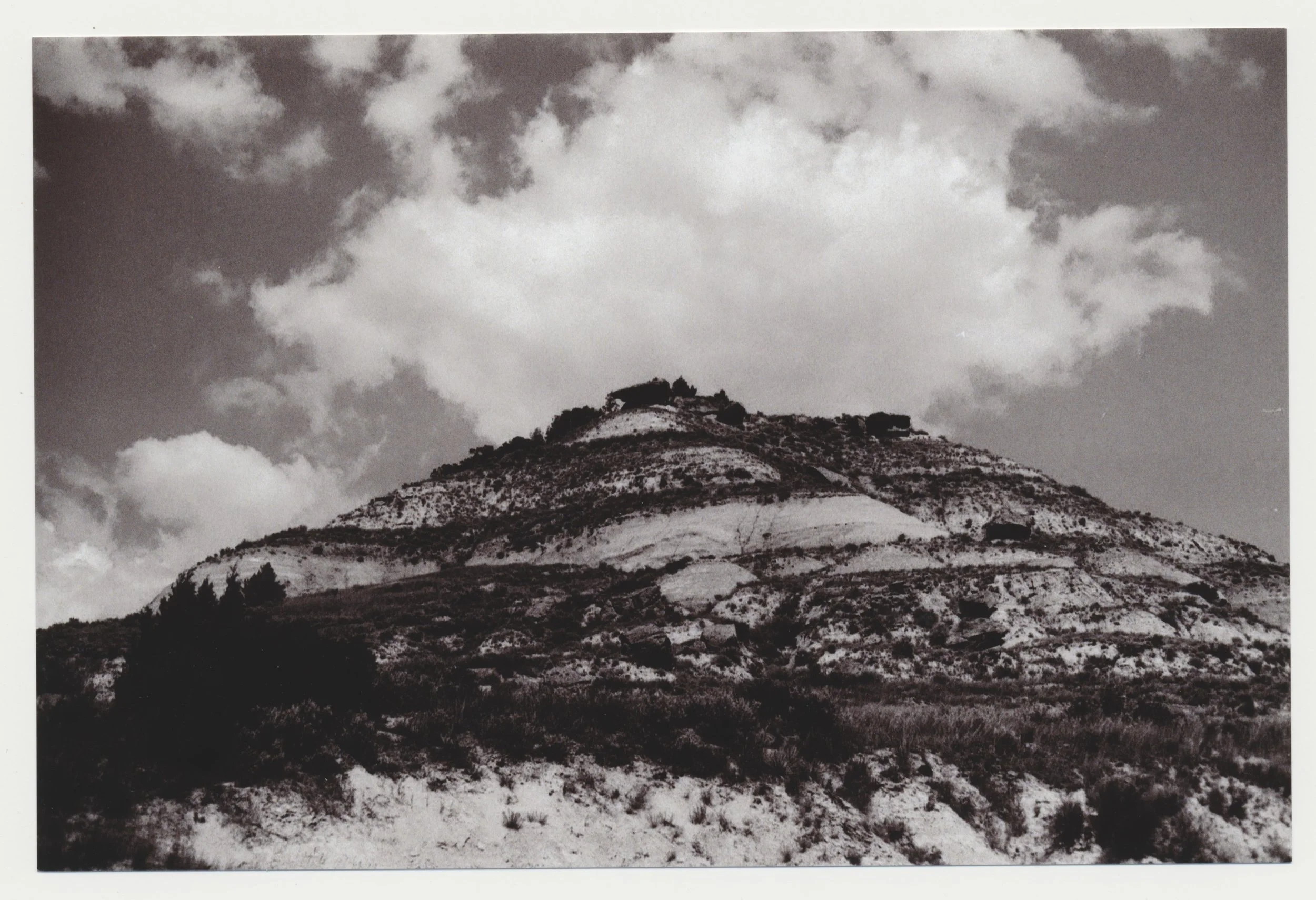
Image: “Badlands 11” by John Plaski
The mare and I canter around the arena. No fence hems us to the worn path—circling, circling—only the fringe of loblollies, water oaks, and red maples doggedly green. Warblers and vireos loiter as if September. Ornery crows caw in warning: Hey Stupid! Too warm! Too late! November. What should not be, is. I should not be, yet here I am drunk on the mare’s moonshine musk—sweat, leather, beeswax, hay. I tip forward, my nose in her sticky mane, inhale deep, deeper.
Reins lace my fingers like the rosary I prayed before I believed. For Thee not for me. Fuck if I knew what else to do those many years ago. (Booze, self-starvation, lithium, one hundred volts to the brain, twenty-five times. Bolt, buck, bite—rifle, bullet, far pasture?) So: why not Our Father, Hail Mary, Glory Be, The Mysteries. Why do you seek the living among the dead? Rise: muck stalls, scrub bit and bridle, pick stones from my heart.
At each footfall, we exhale, the mare and I: out, out. Heels down, toes up, deep seat. Calm line and pace. She carries me, and I try not to burden her, but we are beasts bound to each other. Above, a lone goose flies low—herr-onk herr-onk—a cantor without congregation. We are losing light. Dark soon. Make haste. Somewhere, in pond or pasture, flock and herd wait. I squeeze my calves, lean forward, gather the reins, and the mare? She listens, canters—one, two, three, and on the fourth beat, flies. Ten years out from the worst of it, I ride like this now—steady, alert, alive.
Riding carried me through when my mind bucked and bolted and still steadies me now, a forward-moving ease that I bring to my writing, or try to, anyway? (Though my mare still startles at shadows and I still stumble on the page.) I want ease, but what I’m given is the hard work of holding on. What keeps me riding and writing? Full-bodied, wholehearted presence. When my horse quickens beneath me or a sentence resists my frustrated intent, I cannot slip and slide in panic. Reins and lines require my focus. No room for the past’s recriminations or the future’s catastrophes. For a moment or minute or hour, thought and motion are one. Flow.
• • •
One long-ago April, I had just returned from an inpatient eating disorders hospital out in the Arizona desert, officially healthier and armed with a rigid eating plan. I was tentative, wobbly, and not at all committed to rehabilitation (in living, much less writing, though sometimes they are the same). But I was desperate to return to the stables and the horses rescued from abuse and neglect. I was needed, necessary—at least that’s what Jesse, my riding instructor, told me—“You have a way with horses,” she said. She was a no-nonsense horsewoman, a gruff truth-speaker, so I knew she wasn’t just saying this to puff up my ego.
At the time, I did not believe I had a way with my children nor with my then-husband nor with my words, but maybe horses? That feel of a curry comb circling across a horse’s body, of pressing my face into a horse’s mane, of easing a bridle over a horse’s ears and then one foot in a stirrup and hoisting myself up, of gliding over and onto a horse’s back all at once? That I could do. Balance in the saddle, though not, then, in my marriage nor on the page where I was thrown off time and again. Still, even in those years when I couldn’t imagine a story beyond my own, or believe there was a line worth writing, a life worth living? I could imagine that perfect flying lead change: elevation, alignment, shape, and yes, without hesitation.
• • •
One childhood summer at horse camp, I led my horse, Jester, into the ring, my black hair tucked beneath a velvet helmet. My parents had scraped together just enough to send me to Greenfield Hunt Club, the kind of equestrian camp I’d clipped ads for from the New York Times Magazine. We couldn’t afford the full English riding kit. My mother settled on a helmet and rubber boots, their sharp chemical smell nothing like leather. On the first day, as I walked Jester past the fence, the other girls giggled—What is she even doing here? I pretended not to hear.
But Jester was mine for those few weeks: a gleaming dappled-gray who nickered when I brought him carrots and sugar cubes in the evenings. The other girls didn’t know I had checked out Practical Horsemanship again and again from the Queens library, memorizing gaits, dreaming rides in the dark before sleep, writing them down in a journal. They didn’t know that the lonely girl at horse camp would become a woman who, at thirty-five, wanted to die, and that horses—again—would bring her back to life.
Horses can hear our heartbeat from four feet away. Pressed against Jester’s warm body, I felt our rhythms sync. With my small palm to his ribcage, I felt his big heart beating as if my very own, and yes, he felt mine, too. The very same feeling when imagination and words sync up on the page, rise from dark well into open field, in concurrent beat and rhythm.
Of course, writing, like riding, is risky. Sometimes fear takes the reins, and I am thrown to the ground, dazed at how easily I lose my seat and confidence. Nothing to do but brush off the dust, check my helmet, climb back in the saddle. The sweetness comes in persistence. Writing is the same: pen in hand, I carry words forward, each sentence a hoofbeat, each paragraph a canter, that hard-won rhythm, flying over fences.
• • •
“Things might get wicky wacky for you,” Jesse had said when I came back from that Arizona inpatient program. She gave me a book about a writer who followed a group of horses for a year, from birth to training to racing. An unexpected, tender gift. When I lined up for morning and evening weigh-ins, my success measured by ounces; when I woke up in the middle of the night to do one-thousand secret sit-ups to counter the ounces; when I contemplated running full speed into a saguaro cactus’s spines because I did not hope, I did not want, I did not need, I could not fly? I didn’t imagine that I was in her consideration when I was not in the barn mucking out stalls or on a horse cantering around the arena.
“I worried that things might get wicky wacky for you while you were on…vacation,” she said, which made me laugh. Her way of saying, “Did you behave yourself? Straighten out? Get rescued and rehabilitated?”
She pointed to a new horse, Chandi. “You can start back with him,” she said. I wondered if, after my two months away, I was up to the task. Chandi was a powerful, skittish quarter horse. “He’s wicky wacky, too. You’ll be just right for each other.”
He was indeed wicky wacky—bolted into a frightened, too-fast run whenever a sheet of melting ice slid from the arena roof and crashed to the ground. He startled easily, tightened up, reared back.
“Hold on,” Jesse said. “Sink your seat! Keep cool! Light hands! You didn’t learn that out in the desert?”
How to move forward on the page with light hands and a deep seat? Movement is hard even when it looks easy. One night I was sitting in the bleachers at my son’s soccer game, and a lone, low-flying Canada goose skimmed the field, maybe ten feet above—so close I could hear the rhythmic flapping of its wings, the effort and will to keep moving and stay aloft even on its own, without its flock—to persevere.
Yes, to persevere when it gets wicky wacky, with horses and words. In a memoir workshop, a student asked me, “How do you cross the bridge and dive into painful material and then cross back?”
“It’s not a bridge,” I said. “It’s a door.”
We step over a threshold and are transformed, holding fast to the courage to engage with hard truths and tentative joys, balancing between a sentence’s first word and its end stop period and the risks we take in between—accountability, forgiveness, revelation. We live in between: our birth, the stall door swings open; and our death, we are put out to pasture. Everything in between is uncertain, provisional, wicky wacky, and exactly why we are here.
An early morning lesson. Rain pounded the arena ceiling, wind howled outside, and barn sparrows flitted and darted in warning. Chandi was tense and disorganized: he snorted, hopped away from jumps, and shifted haphazardly from trot to canter to a halting stop. My first fear-filled instinct: control the environment, control Chandi’s fears (and mine!). I kept us to a guarded, tentative walk, and avoided the jumps.
Jesse put a quick end to that. “Easier,” she said, “but you haven’t tried the jumps yet, so you don’t know how he’ll react. Remember: calm line and pace. Courage in the doing, and the doing is the riding.” Is there any difference between a blank page and an open arena, between writing and riding? Both offer…not ease, exactly, but release. Gravity shifts and we move freely forward.
• • •
When I was in that Arizona rehab, my daughter sent me a letter: a drawing of a horse, blocky, Greek, like the bronze horse on display at the Metropolitan Museum of Art in New York City, 8th century BC, Geometric. Many years earlier at the museum, I’d stared at that statue behind the glass, transfixed by the arc of its mane; by the awareness that it was once a real horse slick with sweat and sweet grass; by the thought that a sculptor, long dead, had run his hand along its flank, its withers, down through its forelock to the velvet of its muzzle; and perhaps that his bones lay jumbled with the horse’s beneath a hillside in Corinth, covered in thyme and oregano, bees droning above.
My daughter’s horse was mythic and precise, crayoned in brown and purple. No bridle, just corralled in a purple circle with a tall, spiky, green saguaro cactus standing sentry—as if my daughter sensed my impulsive imaginings. Beside the horse, a drawing of her mother, me. In one of my hands a brush, the other a carrot, offerings to the horse as if an entreaty: Please let me get close, let me help you, touch your warm body, press my face to your shoulder, your mane.
My daughter knew I was caring for horses to learn again how to care for myself. “Here,” her drawing said, “can we do this together?”
At the top, a giant sun, its yellow rays extending across the page, top to bottom, side to side, and a smiley face filling its orange corona. Along the bottom of the drawing, wobbly crayoned letters: “Momma, please ask your doctor when you are coming home. I miss you.”
Mother and daughter, each staring at horses, each asking: how do we learn to live?
I am thinking of that letter in the box under my bed filled with letters from family and friends, varieties of the same entreaty: please yes love don’t die stay with us.
Words move us and writing is movement.
I am thinking of that bronze horse in the Metropolitan Museum behind the glass and a young girl from thousands of years ago, and her wild hair and mud on her calves and under her fingernails and her head resting on that horse’s shoulder in a dusty field in Corinth under the hot, shining sun.
I am thinking about how I am writing about that girl and about my daughter and how mud is under my fingernails and splashed along my calves because I have just returned from riding a gleaming brown mare around an arena under the late afternoon sun—yes, the corona, the crown circling us all.
Riding taught me that steadiness is not the absence of fear but the practice of rhythm—breath, stride, word, line. Writing demands the same: persistence in uncertainty, courage in movement. Both ask me to stay inside the body’s knowledge, to trust the next step. Look, dear reader, dear rider, dear writer! Pay attention! Your very own horse is beside you. One foot in the stirrup and up and over onto its back. Grab a fistful of mane. Gentle pressure and walk on, circling the blank page, clip clop clip clop, one word after the next.
Kerry Neville is the author of the memoir Momma May Be Mad, winner of the Georgia Author of the Year Award in Memoir in 2026, praised in a starred Kirkus review, and featured on NPR’s All Things Considered and RTÉ’s Sunday Miscellany, and two collections of stories, Necessary Lies and Remember to Forget Me. Her work has appeared in publications such as Fourth Genre, The Gettysburg Review, TriQuarterly, Brevity, The Irish Times, and elsewhere. Her fiction and nonfiction have been named Notables in Best American Short Stories and Best American Essays. She was a Fulbright Fellow at University of Limerick in Ireland, where she was visiting faculty in the M.A. Creative Writing Program. She lives in Milledgeville, Georgia, and teaches at Georgia College and State University.
Website: www.kerry-neville.com
Instagram: @kerrynevilleirelandfulbright
John K. Plaski is a queer, neurodivergent author and film photographer from Milwaukee, Wisconsin.
Instagram: @jkpphoto1196