Canarino
by Ayla Gard
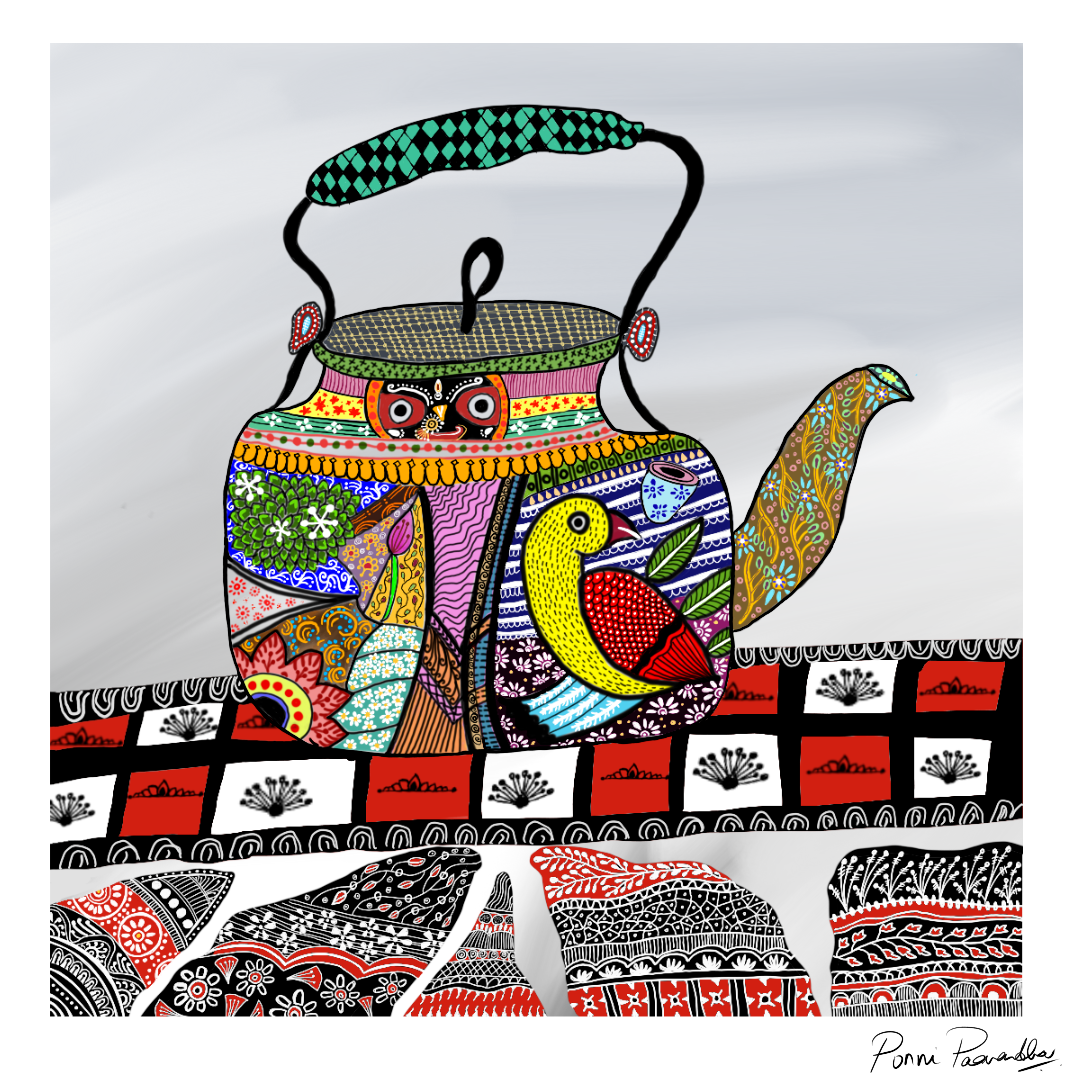
Image: “Cha!” by Tamizh Ponni VP
The doctor stood on my doorstep and held out a brown paper bag. Ginger palm leaves whipped in the wind against the white stucco wall outside. I wondered if it would be jewelry in the paper bag this time. But he’d never given me jewelry. This time it was oranges, from a weekend trip he’d taken with friends to the countryside.
You don’t know them, he said when I asked which friends, then he brought his fingertips to my cheek, because he knew how to stop me from asking questions.
He had dirt beneath the moonwhite of his thumbnail. A curl of chestnut brushed the scar at his temple and my eyes traced a path from his eyebrow down to his bottom lip.
Come inside, I said.
He lived in a different neighborhood now, had only returned from Istanbul a few months earlier, to work at the children’s hospital. A few days after he visited, I developed a fever and I wondered if he’d given me something other than oranges. I took a photo of the thermometer, which read 39.2°C, and texted it to him.
Is this something I should be worried about? I asked.
You should go to the doctor, he said.
I didn’t tell him I’d gone to see a doctor that morning. One I wasn’t in love with.
I don’t think it’s bird flu, I said.
He said, I could have told you that.
On my birthday I was still sick and the doctor came with lemons. For old times, he said. He left the paper bag on the doorstep, then took two steps back into the courtyard. He was wearing a button down shirt and a mask, which he didn’t take off. It was bright red like blood smeared on his face. I wanted his hands on my body.
How is your wife? I asked. I wanted to know if she was still refusing to sign the divorce papers, still hoping he’d change his mind. His wife was still in Istanbul, as far as I knew.
He looked down into the garden, where our lemon tree used to be. It’s a shame our tree died, he said.
I could have told his wife this: he never changes his mind.
The next day he texted to ask how I was and I told him I had glass in my throat.
He said this wasn’t normal and I liked that he said that. You never want your doctor to think you are normal, especially not if your doctor’s naked body has spent so many nights curled around yours like a question mark.
I started to hear from him a few times a day after that. He was worried. His hellos and how are yous were tiny pills I needed for the pain.
When I was better he went quiet again so I asked him over for dinner. I spent the afternoon staring at the white stucco wall, waiting for him to arrive.
By nine he was at the door, guiding my hand into another paper bag. Why would it be jewelry? Apples, this time.
He said they were just going to rot in his fruit bowl.
I’m feeling better, I said.
He kissed me as I cupped the hard fruit in my hand.
You’ve always been good to me, he said.
Later as he watched me chop cucumbers, his cologne hung in the kitchen air like a reminder of the life he had outside this building. I was trying to remember the smell.
You got the wrong cucumbers, he said. The Persian ones taste better.
Then he was behind me, arms around my waist. He breathed on my neck and the knife slipped and I sliced my finger. It was lily of the valley. His fragrance.
He spun me around and held my hand to the light. Two tangled lifetimes reflected on the curved wet surface of a tiny drop of blood.
I told him he knew how to care about me as a doctor but not in any other way.
He laughed, let go of my hand and said, that’s probably true.
* * *
Before he was a doctor, we were neighbors for a long time. I grew up here, and ten years ago, after my mother died, I moved back into this apartment and into her bedroom, which has a garden view. He was living across the courtyard then, so we could both look out our windows and see the lemon tree we’d planted as children. This was while he was still in medical school. Before he went to Istanbul for his fellowship at the hospital where he met his wife and didn’t come back for seven years. Not long after I moved back, we started sleeping together. Grief is weird like that.
One day I was lying in my mother’s bed crying and he heard me from outside. He texted and said, you should make a canarino. Something his Italian grandmother had made for him.
I looked up ‘canarino’ and found out it means little canary. You peel off some of the lemon skin, no pith, just peel, and you put it in a cup and pour boiling water over it. The water turns bright yellow, like the bird.
He left two lemons by my front door that evening, and he must have found a ladder, because he started leaving lemons from the tree on my doorstep every day. For the canarinos, he said. After that I started drinking canarinos every day. Long nights of secret drinking made my skin the color of Valentine’s Day, but the canarinos seemed to help.
One morning we were lying in my bed and I told him about canaries and how people once used them to detect poisonous gases in mines. If the air was poisonous, the canary died. It was really an awful way to treat a bird.
He said he knew about this, of course, and I reminded him about the time I had lost my sense of smell and accidentally left the gas burner on with no flame for an hour. A canary would have been useful in that situation.
Does it make you uncomfortable that we live so close to each other? I said another time, as we lay on the rug in his living room, the sun on our faces.
He said, haven’t we always?
Always what?
Lived close, been close.
Loved each other, I thought but didn’t say.
Some people with pet canaries give them lettuce to help with their digestive systems. I could spend hours researching useless things. That day I had gone on a canary deep dive. Some people give their canaries cuttlebones, for their beaks. Maybe I could have been an ornithologist, if I’d finished college instead of moving back here. I moved back to be closer to him, but now, with his body pressed against mine, I felt further away.
You do love birds, he said.
I asked him what his top three birds were and he said, I guess I like condors. Sometimes he pretended to care about the things I cared about.
My top three birds are blue-headed parrots, northern cardinals, and the long-wattled umbrellabird. That last bird looks like it’s going to break your heart by making out with Pia Castelluzzo behind the gymnasium after school. I don’t know why I’ve always been attracted to the things that hurt me.
* * *
When I was eight years old, I had a budgerigar. Yellow and green. I didn’t know if it was a boy or a girl but I gave it cuttlebones. I don’t agree with keeping birds in cages anymore but back then I hadn’t formed an opinion on it. Then it died for no reason. So he came over, and we dug a grave for the dead budgie in the garden outside my mom’s bedroom window.
This was before he was a doctor, before he moved into the building to be closer to me and my mother, back when he was still a boy and always just visiting. At the bird funeral, we buried the tiny body in a coffin made of a shoebox. The bird was definitely dead but it was still warm. It was like holding a piece of fruit that had been left out in the sun. I cried a bit and he put his hand on my shoulder and told me that death was normal and someday we’d all end up decomposing in a shoebox. He was nine, my best friend at school, and in life.
My mother took us both to the beach a few times that summer. He kept his long sleeve shirt on so she wouldn’t see the arm bruises from his father. I saw them twice, but we never talked about it, nor about the time his mother had dropped him off with a black eye and stitches at his eyebrow. We’d walk along the sand and pop the little bubbles in the seaweed so the salt water would ooze out. Sometimes we’d find cuttlefish bones, and we’d rinse off the sand and put them in our pockets to take home for the budgie. Before it died, that’s how we got the cuttlebones. We didn’t buy them at the pet store because my mother said we needed to save money, and beach cuttlebones were free except for the parking.
One afternoon when he didn’t want to go back to his own house, we were jumping on my mother’s bed and I fell and knocked my head on the window sill. It wasn’t bad, but I was in shock. He kneeled over me on the floor and looked into my eyes. I tried to rub away the tears.
Keep still, he said. I’m doing an examination.
You should be a doctor, I told him.
He narrowed his eyes and looked away.
After the examination we crawled back onto the bed and I asked him to tell me a story.
Okay, he said. I read a true story this morning, about a boy that found a dried fox in his grandfather’s cupboard.
Like a taxidermy?
I don’t know what that is, he said. It was a real fox, but dead and dry. With glass eyes.
That’s weird.
Yes, he said. There was a lemon tree in the backyard, and the boy picked the lemons and put them in the mouth of the fox in the cupboard, because he realized that feeding lemons to the dead fox with glass eyes made it come back to life. In the end, the lemon tree died and the fox in the cupboard walked outside, and the boy never saw it again.
That’s the story?
Yeah.
You’re sure that’s true?
Cross my heart.
I looked over at him and he had tears in his eyes then. Like dead fox glass eyes.
That was when we decided to plant a lemon tree in the garden. We pressed a seed into the ground outside and a month later there was a seedling, a year later, a tree.
* * *
The tree was here for twenty-five years. It was here when we were eighteen and the boy ran away from his father and moved into the building, and it was here when, a year later, I told him I was leaving for college. It was here when my mother died and I moved back, when he became a doctor, and when, a few years after that, he called from Istanbul and told me he was getting married. For a long time it grew upward while we grew into and then apart from each other, the lemon tree, the doctor, me. It died a few years ago. I don’t know why.
I still think about that dead fox story sometimes. Then I think about little canaries. They’ve all been absorbed back into the strange currents of life by now, are all made of dust, carried on the winds that whip the ginger palm leaves. When I peel the skin of a lemon and let its color drain into a cup of hot water, I know there’s canary dust in that cup, too. If it makes me sick, I will text the doctor.
Ayla Gard writes fiction, nonfiction and poetry. Her nonfiction work has appeared online in Orion and Scientific American and her fiction was shortlisted for the 2025 Bridport Prize. She holds an MFA in Nature Writing from Western Colorado University and lives in Los Angeles where she works in climate communications. Find her at aylagard.carbonmade.com or on IG @aylagardening
Tamizh Ponni VP is an ambivert and a stoic art buff who loves to express her skills through literature, visual arts and music. She is an IB educator and sees learning as a life-long process. Her stories were featured in two anthology books, Mia and Varna. Tamizh's articles, poems and paintings have also been published in many digital journals and educational blogs. Tamizh spends most of her free time painting, reading, writing articles, stories and poems, playing piano and watching documentaries/movies.
Social Media Handles: LinkTree- https://linktr.ee/TamizhPonniVP Facebook: https://www.facebook.com/tamizhponni.vp/ Twitter: https://twitter.com/Madhu7777 IG: https://www.instagram.com/cassandraclicks/